Lead Paint in Heritage Buildings: What NSW Law Requires Before You Paint
By Tony Conway, Managing Director, Premier Painting Company
Quick answer: Lead paint management in NSW is governed by the Work Health and Safety Regulation, the Heritage Act 1977, and NSW EPA disposal requirements. Most Australian buildings painted before 1970 contain lead based paint, so any work likely to disturb it must be assessed, notified to SafeWork NSW where required, and carried out by trained contractors. Premier Painting is trained and compliant to AS/NZS 4361.2 for lead paint hazard management.
Heritage buildings are among the most rewarding properties to restore, and the most regulated to paint. Almost every heritage property in NSW predates the phase-out of lead paint, so proper lead paint management is not optional: it is a legal requirement under work health and safety law, heritage law and environmental protection law. This guide explains what those laws require before a brush touches the building, and what to expect from a heritage painting company that takes compliance seriously.
Why Do Almost All NSW Heritage Buildings Contain Lead Paint?
Lead paint was used in most Australian homes built before 1970, and the older the building, the higher the likely lead content. Because heritage buildings by definition predate this era, the presence of paint with lead in it should be assumed on any heritage project until testing proves otherwise.
Under the Work Health and Safety Regulation, as reflected in NSW Government lead paint policy, the key terms are defined as follows:
- Lead paint: any paint, stain, varnish or other applied coating containing 1 milligram per square centimetre of lead or more, or 1 per cent lead by dry weight.
- Lead process: work that exposes a person to lead dust, fumes or mist, including dry sanding, scraping or removing lead based paint.
- Lead risk work: work in a lead process likely to raise a worker's blood lead level above 5 micrograms per decilitre for a female of reproductive capacity, or 20 micrograms per decilitre in other cases.
This matters because coatings accumulate. Part of the reason heritage properties are harder to paint than modern buildings is exactly this: decades of layers, with the oldest and most hazardous coats at the bottom, over fragile substrates that cannot tolerate aggressive preparation.
What Does NSW Law Require Before Lead Paint Work Begins?
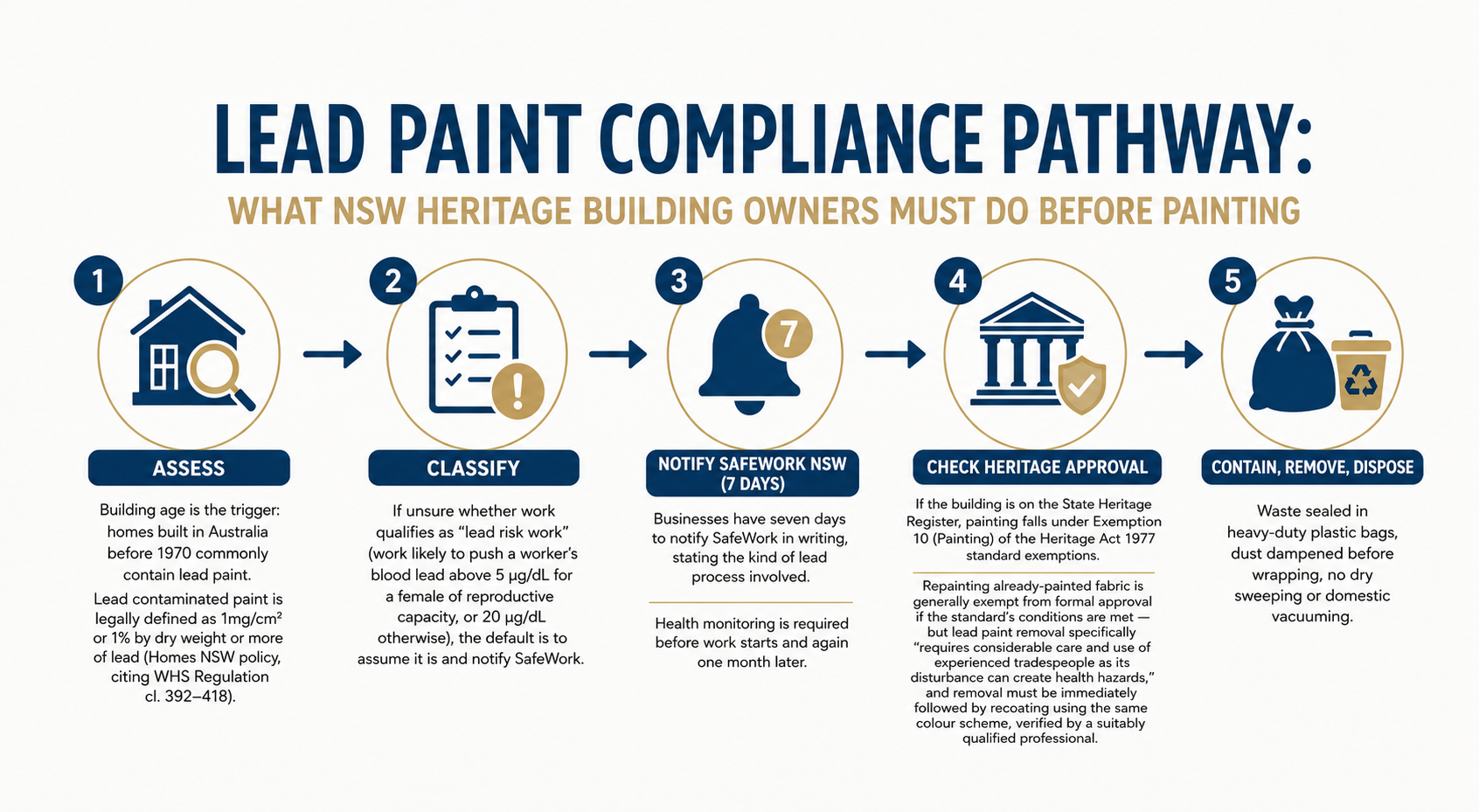
Once a surface is identified or assumed to contain lead based paint, lead paint management follows a clear compliance sequence under the Work Health and Safety Regulation. In practical terms, these obligations fall on the contractor performing the work, which is why engaging a compliant contractor removes most of the burden from the building owner.
- Assess the work. The contractor determines whether the scope constitutes lead risk work. SafeWork NSW guidance is direct on this point: if in doubt, assume it is.
- Notify SafeWork NSW. Lead risk work must be notified to SafeWork NSW in writing within 7 days, stating the kind of lead process involved.
- Arrange health monitoring. Workers carrying out lead risk work must receive health monitoring before starting and again one month after, with ongoing blood lead testing at intervals set by the results. The contractor bears all associated medical costs.
- Contain the work area. Lead work must be restricted to a defined lead process area, with contamination confined to that area, decontamination procedures in place, and no eating or drinking within it.
- Dispose of waste correctly. Lead contaminated debris, dust and protective equipment must be sealed and disposed of in line with NSW EPA requirements, covered in detail below.
None of this is discretionary. A professional contractor should be able to show you notification records, safe work method statements and health monitoring arrangements on request.
Do You Need Heritage Approval to Paint Over Lead Paint?
For buildings on the NSW State Heritage Register, painting is covered by the standard exemptions under the Heritage Act 1977. Repainting fabric that is already painted, including surface preparation and removal of failed paint, generally does not require a formal works approval, provided strict conditions are met.
Those conditions are not trivial. The painting exemption only permits disturbance of earlier paint layers that have already failed by chalking, flaking, peeling or blistering. Paint removal methods must be verified by a suitably qualified and experienced professional as safe for the significant fabric, and removal must be immediately followed by recoating in a sympathetic colour scheme. The exemption also carries a specific caution on lead: removal of paint with a high lead content requires considerable care and experienced tradespeople, because disturbing it creates health hazards.
Two caveats apply. First, the exemptions never permit painting previously unpainted significant fabric such as face brickwork or stone, and never permit damage to significant fabric. Second, buildings that are locally heritage listed rather than State listed fall under council planning controls, and requirements vary between local government areas. Confirming the listing status and approval pathway is part of proper scoping, and it is work your heritage contractor should complete before quoting, not discover mid-project.
Premier Painting's painting and compliance services include lead paint hazard management, heritage-appropriate paint systems and dedicated project management, so heritage owners have one accountable contractor managing compliance from assessment through to disposal.
How Do You Check for Lead Paint?
A lead paint check starts with the building's age: anything painted before 1970 should be treated as containing lead paint until tested. On heritage buildings the question is rarely whether lead is present, but where, in what condition, and at what concentration.
There are two ways to test for lead paint:
- DIY test kits from hardware stores use a chemical swab that changes colour on contact with lead. They are inexpensive and useful as a first indication, but they only test the surface layer and can miss lead buried under newer coatings.
- Professional testing, using laboratory analysis of paint samples or X-ray fluorescence (XRF) equipment, identifies lead through the full depth of the coating system and gives certified results that support heritage documentation and safe work planning.
Premier Painting assesses suspect surfaces during the pre-paint inspection and arranges certified testing wherever results affect scope or cost. Knowing how to check for lead paint properly at the start prevents the most expensive scenario in heritage house painting: discovering lead mid-project, after dust has already spread.
Pro tip: Intact, well-adhered lead paint is not a hazard in itself. The risk begins when it is sanded, scraped, heated or left to deteriorate. This is why a condition assessment matters more than a blanket removal policy: on many heritage surfaces, the safest and most conservation-appropriate approach is to stabilise and encapsulate rather than strip.
Removal, Encapsulation or Painting Over: Choosing the Right Approach
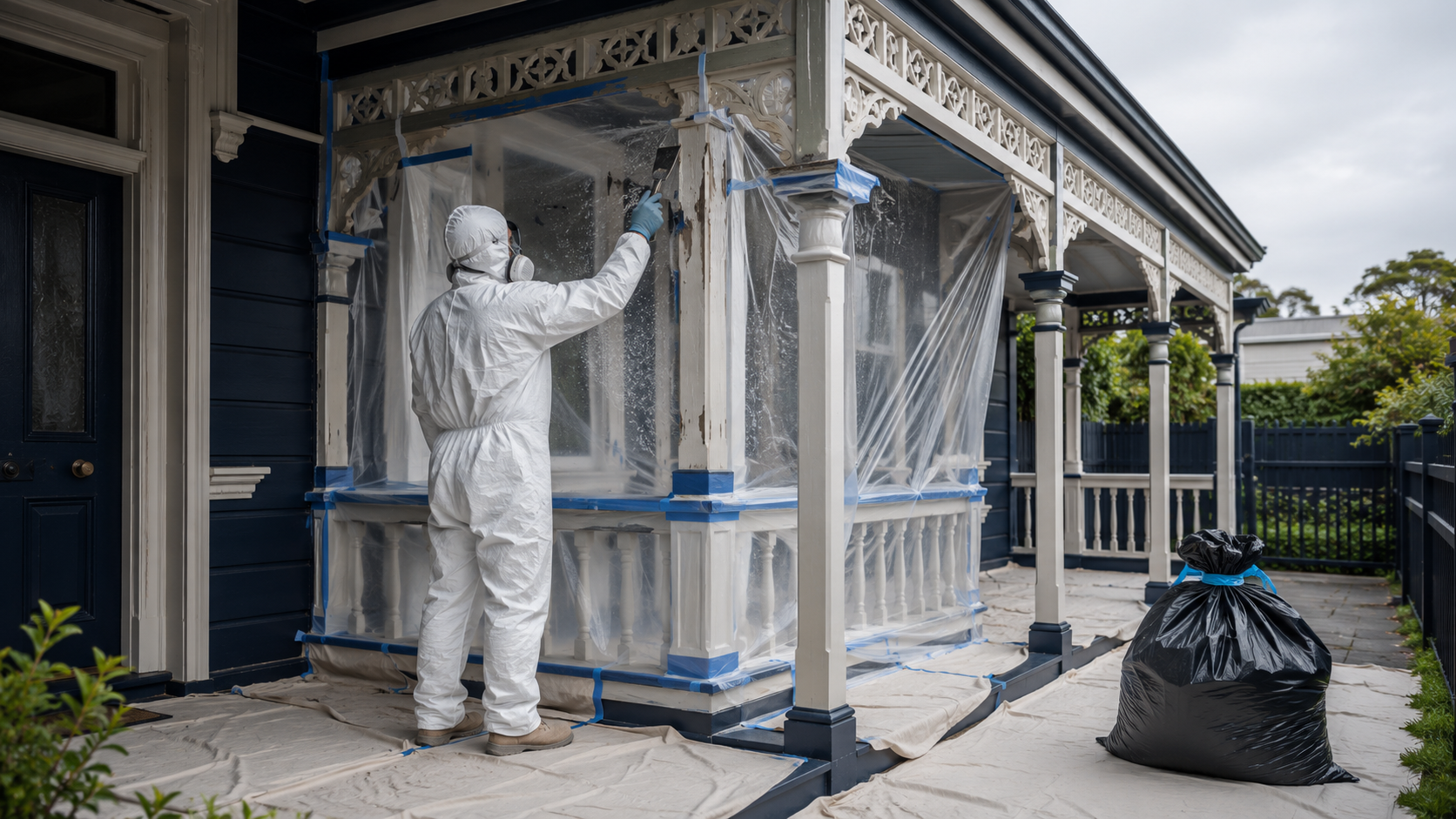
There is no single correct answer for every surface. Good lead paint management matches the method to the condition of the paint, the significance of the fabric beneath it, and how the surface is used. The comparison below reflects how these decisions are typically made on NSW heritage projects.
Full removal is the most involved and most expensive option, and on heritage fabric it is not automatically the best one: aggressive stripping can damage significant fabric and destroy the historical paint record heritage controls exist to protect. For lead paint removal in Sydney's heritage precincts, from Federation terraces to sandstone institutions, the specification should always come from a condition assessment, not a default.
How a Heritage Painting Company Manages Lead Paint Compliance
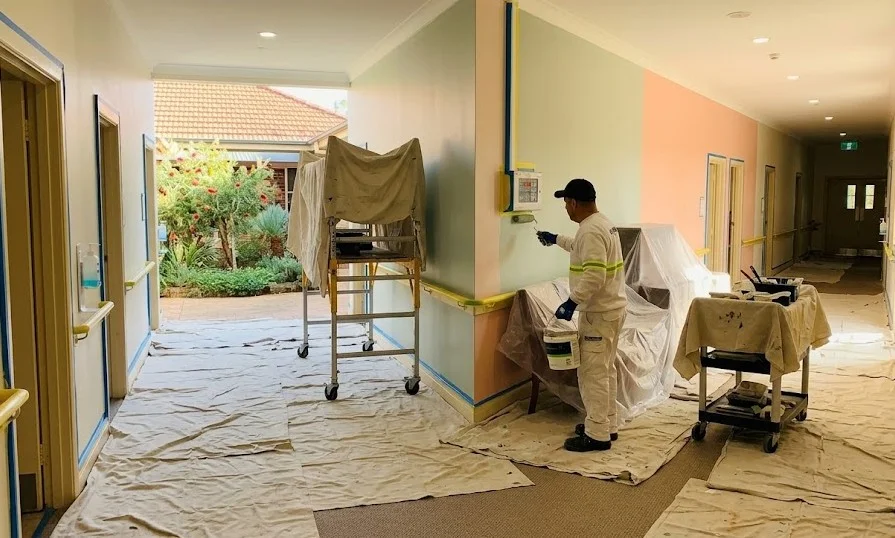
The value of an experienced heritage painting company is that lead paint management becomes the contractor's job, not yours. On Premier Painting heritage projects, that looks like this:
We assess before we quote. Suspect surfaces are identified during the pre-paint inspection and testing is arranged where needed, so lead paint in homes and public buildings is priced into the scope from day one rather than surfacing as a variation.
We classify and notify. Where the scope constitutes lead risk work, we manage the SafeWork NSW notification within the legislated 7-day window and maintain worker health monitoring, backed by training and compliance to AS/NZS 4361.2 for lead based paint hazard management.
We work within heritage controls. As preferred painters to the Historic Houses Trust of NSW, with projects including Government House, NSW Parliament and Hyde Park Barracks, our teams work to heritage exemption conditions as standard practice: appropriate removal methods, sympathetic recoating, and protection of significant fabric throughout.
We contain and dispose correctly. Work areas are contained, dust is suppressed with wet methods, and all lead contaminated waste is sealed and disposed of in line with NSW EPA lead safety requirements, protecting residents, neighbours and site drainage.
Every project is overseen by a dedicated Project Manager and Supervisor and backed by our 7-year workmanship warranty, across Sydney, the Central Coast and Wollongong.
TL;DR: Lead Paint in NSW Heritage Buildings at a Glance
- Most Australian buildings painted before 1970 contain lead paint, and heritage buildings almost always do.
- Lead paint is defined as a coating with 1 per cent lead by dry weight (or 1mg/cm²) or more.
- Lead risk work must be notified in writing to SafeWork NSW within 7 days, with worker health monitoring before and during the work.
- Under the Heritage Act 1977 standard exemptions, repainting already painted fabric usually needs no formal approval, but lead paint removal must be handled by experienced tradespeople under strict conditions.
- Lead contaminated waste must be wetted down, sealed and disposed of to NSW EPA requirements, never placed in general rubbish.
- Next step: contact Premier Painting for a free quote → 1300 916 291 or premierpainting.com.au/request-a-quote/
Book a Lead Paint Assessment for Your Heritage Building
Premier Painting has managed lead paint on some of NSW's most significant heritage properties for 28+ years. Call us on 1300 916 291 or request a free quotation online and your building will be assessed before any scope is finalised.
Frequently Asked Questions
Is lead paint illegal in NSW?
No. Owning a building with lead based paint is not illegal in NSW, and intact lead paint in good condition is not considered a hazard. What the law regulates is the work: disturbing, removing or managing paint with lead in it must comply with the Work Health and Safety Regulation, SafeWork NSW notification requirements and NSW EPA disposal rules.
Do I need council or Heritage approval to paint over lead paint on a heritage building?
Often no formal approval is needed. Repainting already painted fabric on a State Heritage Register building is covered by a standard exemption under the Heritage Act 1977, provided strict conditions are met, including sympathetic colour schemes and experienced tradespeople for any lead paint removal. Locally listed buildings fall under council planning controls, so always confirm the listing status before work begins.
How do I know if my building has lead paint?
Age is the first indicator: most Australian buildings painted before 1970 contain lead paint. To check for lead paint, DIY swab kits give a quick surface indication, but professional testing is far more reliable on heritage buildings with many paint layers. Premier Painting assesses suspect surfaces during pre-paint inspections and arranges certified laboratory testing where results need to be definitive.
Can a painter just paint over lead paint instead of removing it?
Yes, in many cases. If lead based paint is stable and well adhered, encapsulating it under a new compatible coating is often the safest and most cost-effective approach because it avoids creating lead dust. Painting over is not appropriate where paint is flaking, chalking or on friction surfaces such as windows and doors. A qualified contractor assesses which approach suits each surface.
What happens to the paint waste after lead paint removal?
Lead contaminated waste can never go in general site rubbish. Debris, dust and used protective equipment must be wetted down, sealed in heavy-duty plastic bags and disposed of in line with NSW EPA requirements. Premier Painting manages containment and disposal on every lead based paint removal project, protecting residents, neighbouring properties and site drainage from contamination.
Related Guides
- Do's and Don'ts of Renovating Heritage Properties
- How to Renovate a Heritage Home
- Heritage Building Painting
- How Paint Maintenance Extends the Life of a Building Finish
About Premier Painting Company: Premier Painting has delivered commercial, strata, residential and heritage painting across Sydney, the Central Coast and Wollongong for 28+ years. Dulux Accredited Painters, a member of Master Painters Australia, CM3-accredited, trained and compliant to AS/NZS 4361.2 for lead paint hazard management, and preferred painters to the Historic Houses Trust of NSW. Contact us on 1300 916 291 or visit premierpainting.com.au.







.png)

.png)