School and University Painting: Minimising Disruption to Learning in NSW
By Tony Conway, Managing Director, Premier Painting Company
Quick answer: School painting services in NSW are best delivered through holiday-window scheduling, out-of-hours work, and staged access planning, using low-VOC paints certified for occupied learning environments. Premier Painting has painted NSW public schools and university facilities including UNSW over 28+ years, with Working With Children Checks held by relevant staff, CM3-accredited safety systems, and a 7-year workmanship warranty on every project.
Every school and university repaint carries the same tension: the buildings need protecting, but the timetable cannot stop. School painting services that work in NSW are built around that reality, with the programme planned around term dates, exam periods, and daily operations rather than the other way round. This guide covers when painting work should be scheduled, how staged access keeps a campus running, which paints are safest for learning spaces, and the compliance requirements every educational facility in NSW should expect from building painting contractors.
Why Is Painting a School Different from Standard Commercial Work?
Educational facilities combine three constraints that rarely appear together on other commercial sites: children and young people on site, a fixed academic calendar, and public accountability for every contractor decision. Each one changes how the work must be planned and delivered.
Child safety obligations mean every person attending an operating school should be identifiable, inducted, and appropriately screened. The academic calendar means the largest work windows arrive only four times a year, and they are short. And because most schools answer to a department, a diocese, a board, or a parent community, the documentation standard is closer to government procurement than to a typical office repaint: safe work method statements, insurance certificates, product specifications, and access protocols agreed in writing before anyone opens a tin.
Add older building stock into the picture, where pre-1970s paint layers may contain lead, and it becomes clear why school building painting is a specialist discipline rather than a standard commercial job with a different address.
When Should Painting Work Be Scheduled in Schools and Universities?
The default answer is the holiday window. Schools Infrastructure NSW's planned maintenance programme deliberately schedules internal and external painting during school holidays so work can proceed without disrupting learning, and the same logic applies to independent schools and universities.
The NSW calendar offers four windows a year. The summer break is the longest and suits full interior programmes: classrooms, corridors, halls, and libraries can be completed wing by wing with no students on site. The shorter term breaks suit staged sections, such as one building or one floor per break, delivered across a planned maintenance cycle.
Not everything has to wait for holidays. Exterior painting sits outside occupied learning spaces, so facades, roofs, covered walkways, and perimeter structures can often proceed during term with the right access controls in place. Out-of-hours and weekend work covers the remainder: staff rooms, administration areas, and high-traffic interiors that cannot be released during the day.
Pro tip: A two-week NSW holiday break is typically only eight or nine working days once site induction, curing times between coats, and handover inspections are counted. Lock in scope confirmation, colour approvals, and access arrangements during term, so painting starts on day one of the break rather than day three.
How Does Staged Access Keep a School Operating During Term-Time Painting?
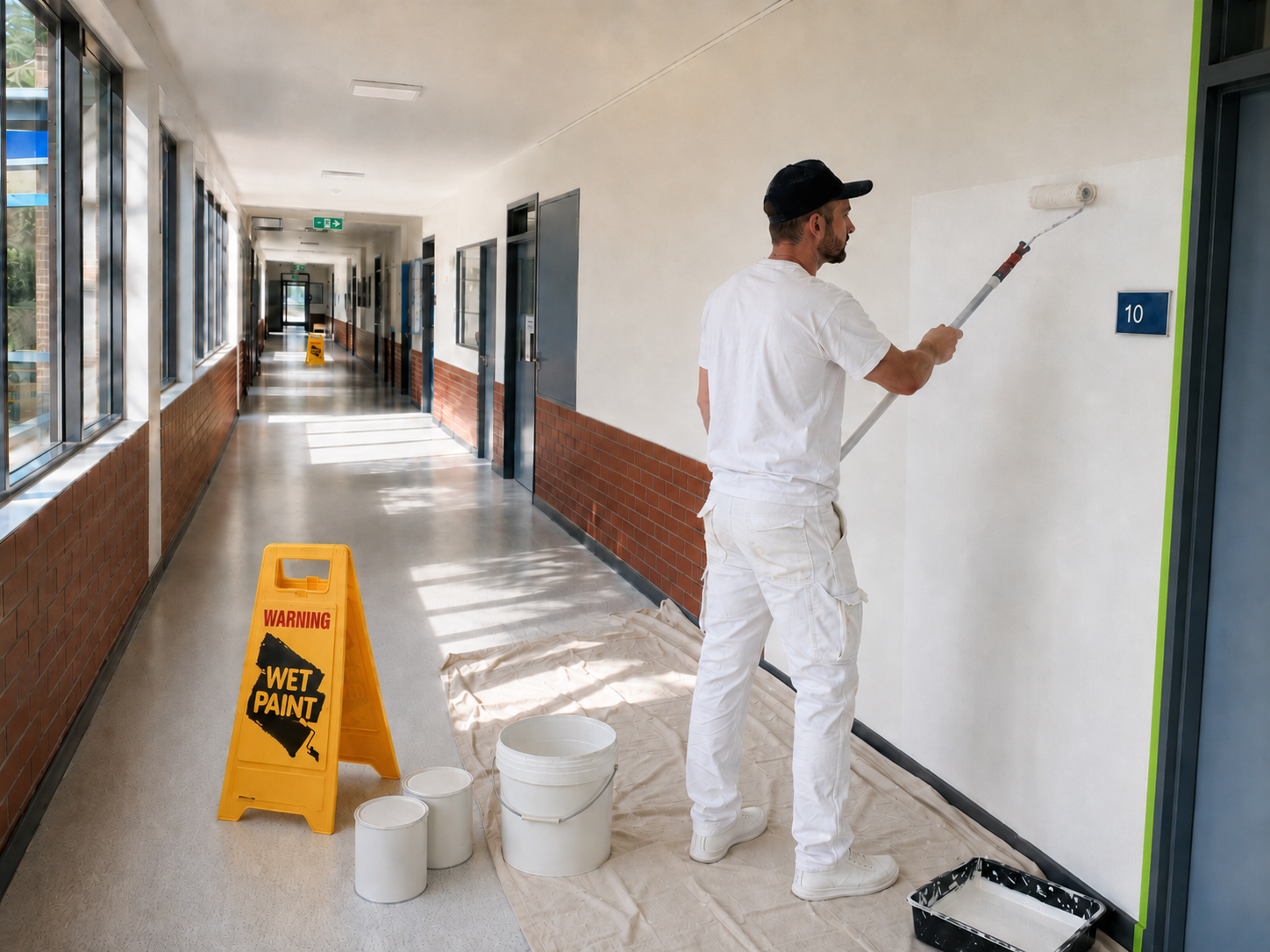
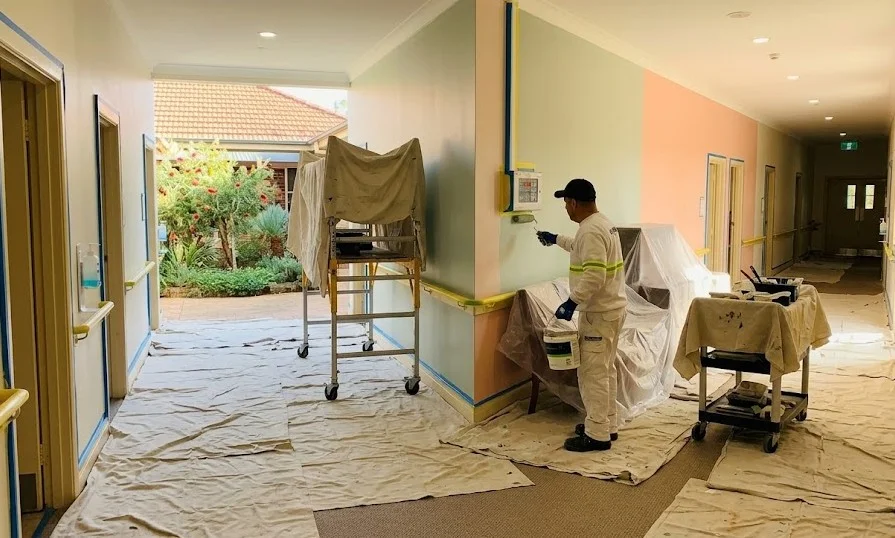
Staged access divides the site into controlled work zones so that painting proceeds in one area while normal operations continue everywhere else. Done properly, students and staff never share a space with wet paint, equipment, or trades.
In practice, this means physical separation of work zones with clear signage and barriers, agreed sign-in and sign-out protocols for every contractor, locked storage for materials and equipment, and a daily handover so the school always knows which areas are in use. Odour and re-entry timing are managed by specifying low-odour, water-based systems and confirming ventilation and re-occupancy periods for each zone before work begins.
Noise is planned with the same discipline. SafeWork NSW's guidance on noise at work covers controlling noise hazards on site, and in a school context the practical extension is simple: noisy preparation work such as sanding, grinding, and pressure washing is scheduled outside teaching hours, while quiet application work can proceed nearby during the day where zones are properly separated.
Premier Painting's commercial painting services include staged programming and out-of-hours delivery for schools, universities, and childcare centres across Sydney, the Central Coast, and Wollongong, with a dedicated Project Manager and Supervisor on every project.
Which Paints Are Safest and Most Durable for Learning Spaces?
For occupied learning environments, the specification starts with low-VOC, water-based acrylic systems. Volatile organic compounds are the chemicals that vaporise as paint dries, and the Green Building Council of Australia links lower VOC levels directly to better indoor air quality and occupant health. Children are more sensitive to indoor pollutants than adults, which is why low-VOC products are now the accepted baseline for classrooms, childcare rooms, and libraries.
Independent certification takes the guesswork out of product claims. Good Environmental Choice Australia (GECA) maintains an ecolabel standard for paints and coatings that benchmarks low-VOC, non-toxic products, and the major Australian manufacturers, including Dulux, Taubmans, Wattyl, and Resene, all produce certified or low-VOC ranges suitable for education settings.
Safety is only half the specification. School surfaces take more punishment than almost any commercial environment, so durability and washability matter just as much as emissions. The right system varies by area:
What Compliance Requirements Apply to Painting Educational Facilities in NSW?
There is no single Australian Standard titled "school painting", but a defined set of requirements applies whenever painting work enters an educational environment, and an experienced contractor manages all of them within one framework.
Working With Children Checks apply to contractors attending operating schools and childcare centres. Site safety documentation, including safe work method statements and current insurance certificates, should be provided and agreed before commencement, and contractor management platforms such as CM3 give schools and government bodies independent verification of a contractor's safety systems. Premier Painting is CM3 accredited and WHS compliant, with Working With Children Checks held by relevant staff and background-screened teams available for government sites.
Older buildings introduce hazardous materials obligations. Paint applied before 1970 commonly contains lead, and AS/NZS 4361.2 governs how lead-based paint is assessed and managed on buildings. Schools Infrastructure NSW routinely runs lead and asbestos remediation during holiday windows for exactly this reason. Premier Painting is trained and compliant to AS/NZS 4361.2 for lead paint hazard management and also provides asbestos encapsulation where required, so hazardous surfaces are identified and treated within the painting programme rather than discovered mid-project.
How Does University Painting Differ from School Painting?
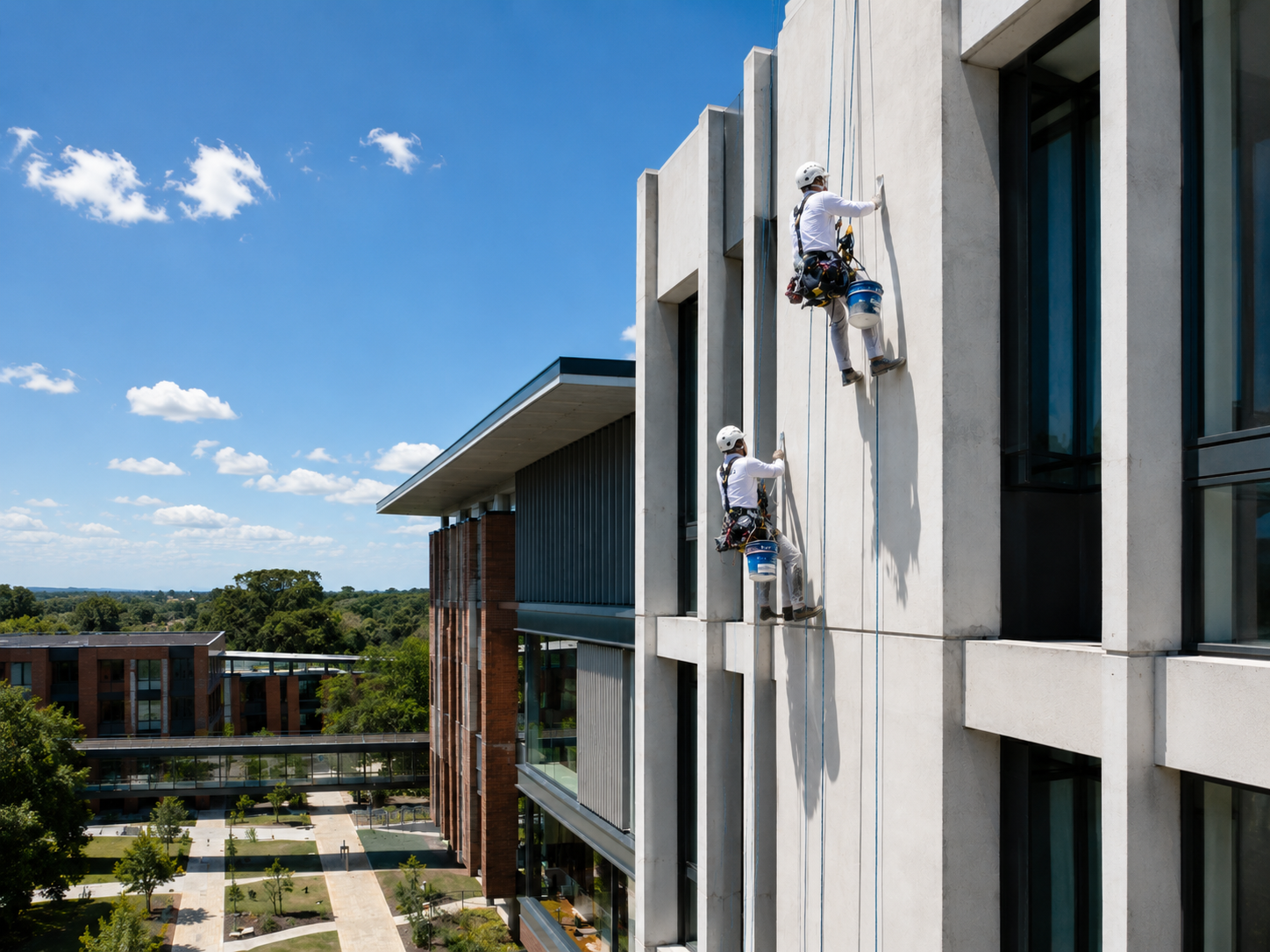
Universities trade the hard boundaries of school holidays for a more complex calendar: semesters, exam periods, graduations, conferences, and residential colleges that never close. University painting is programmed around that calendar building by building, with exam periods treated as no-work zones for noise and access, and high-traffic teaching spaces released during semester breaks.
Scale changes the access picture too. Multi-storey towers, atriums, and heritage facades often make scaffolding impractical or disproportionately expensive, which is where rope access painting earns its place. Premier Painting's abseiling teams are IRATA-certified and deliver exterior programmes on high-rise and hard-to-reach campus buildings with minimal ground-level disruption.
The other difference is continuity. A university campus is a long-term asset portfolio, and the most cost-effective approach is a rolling programme of planned maintenance painting schedules rather than reactive one-off repaints. Premier Painting has delivered painting programmes at UNSW alongside NSW public schools, so the same compliance framework scales from a single primary school block to a full campus.
How to Choose School Painting Contractors: A Practical Checklist
When assessing school painting contractors, facility and business managers can cut through marketing claims with seven direct checks:
- Verify Working With Children Checks for every person who will attend site, not just a company-level statement.
- Request SWMS, insurance certificates, and CM3 or equivalent accreditation before commencement, and confirm they arrive without chasing.
- Ask for education-sector references: named schools, universities, or childcare centres, with the scope and dates of the work.
- Confirm the low-VOC specification in writing, with the actual product names on the quote rather than a general "child-safe paints" claim.
- Scrutinise the programme against your calendar: which zones, which dates, what happens if weather or access slips, and how re-entry times are managed.
- Check the warranty: Premier Painting provides a 7-year workmanship warranty, with manufacturer warranties of up to 10 years available on specified systems.
- Confirm who runs the site day to day. A dedicated Project Manager and an on-site Supervisor should be named in the proposal, so the school always has one point of accountability.
TL;DR: School and University Painting at a Glance
- Schedule interior painting into holiday windows; summer suits full programmes, shorter breaks suit staged sections, and exteriors can often proceed during term.
- Staged access with zoning, sign-in protocols, and out-of-hours noisy work keeps a school or campus fully operational during painting.
- Specify low-VOC, washable acrylic systems for learning spaces, with antimicrobial coatings in wet areas and two-pack epoxy in labs and plant rooms.
- Expect full compliance as standard: WWCC, SWMS, CM3 accreditation, and AS/NZS 4361.2 lead paint management on older buildings.
- Universities need semester-based programming, IRATA-certified rope access for high-rise buildings, and rolling maintenance schedules across the campus.
- Next step: contact Premier Painting for a free quote on 1300 916 291 or via premierpainting.com.au/request-a-quote.
Book a Free Site Assessment for Your School or Campus
Premier Painting delivers school painting services and university programmes across Sydney, the Central Coast, and Wollongong, with every project built around your academic calendar. Call 1300 916 291 or request a free quotation to arrange a site assessment.
Frequently Asked Questions
What are the best durable paint types for Australian school interiors?
Washable, low-sheen low-VOC acrylics are the standard for classrooms and corridors because they withstand repeated cleaning without losing their finish. High-traffic zones benefit from scuff-resistant formulations, while wet areas suit antimicrobial coatings. Premier Painting specifies systems from Dulux, Taubmans, Wattyl, and Resene, matched to each area's traffic and cleaning regime.
How do I choose eco-friendly paint for an educational facility?
Look for low-VOC or no-VOC water-based products carrying independent certification such as GECA (Good Environmental Choice Australia). The Green Building Council of Australia links lower VOC levels to better indoor air quality, which matters most in enclosed classrooms and childcare rooms. A qualified contractor should name the certified product on the quote, not just describe it as eco-friendly.
Do painters working in NSW schools need a Working With Children Check?
Yes. Contractors attending an operating school or childcare centre in NSW should hold current Working With Children Checks, alongside site-specific SWMS and insurance certificates provided before commencement. Premier Painting's relevant staff hold WWCC clearances, and the company is CM3 accredited, which streamlines contractor approval for schools and government facilities.
Is antimicrobial paint worth using in education buildings?
In targeted areas, yes. Antimicrobial paints inhibit mould and bacterial growth on the coating surface, which suits toilets, canteens, change rooms, and other humid, high-cleaning zones. They are not necessary for every classroom wall, where a standard washable low-VOC acrylic delivers better value. The right approach is area-by-area specification rather than a blanket product choice.
When is the best time to paint a school in NSW?
The summer holiday break offers the longest uninterrupted window and suits large interior programmes. Shorter term breaks work for staged sections, while exterior painting sits outside occupied spaces and can often proceed during term with appropriate access controls. Schools Infrastructure NSW deliberately schedules planned maintenance painting during holidays for this reason.
Are there Australian regulations for painting educational facilities?
There is no single school painting standard, but several requirements apply: AS/NZS 4361.2 governs lead paint management on older buildings, SafeWork NSW requirements cover site safety and noise, and Working With Children Check obligations apply to contractors around children. Painting systems themselves follow AS/NZS 2310 and manufacturer specifications. An experienced contractor manages all of these within one compliance framework.
Related Resources
- Low-VOC Paints for Commercial Spaces: What Every Facility Manager Should Know
- Our Commercial Painting Services
- Rope Access Painting vs Scaffolding vs EWP
- Our High Rise Painting Services
- How Paint Maintenance Extends the Life of a Building Finish
About Premier Painting Company: Premier Painting has delivered commercial, strata, and residential painting across Sydney, the Central Coast, and Wollongong for 28+ years, including projects at UNSW and NSW public schools. Dulux Accredited Painters, a member of Master Painters Australia, CM3 accredited, IRATA-certified for rope access work, and trained and compliant to AS/NZS 4361.2 for lead paint management. Every project has a dedicated Project Manager and Supervisor and is backed by a 7-year workmanship warranty. Contact us on 1300 916 291 or visit premierpainting.com.au.







.png)

.png)