Low-VOC Paints for Commercial Spaces: What Every Facility Manager Should Know
By Tony Conway, Managing Director, Premier Painting Company
Quick answer:Low-VOC paints for commercial spaces contain fewer than 50 g/L of volatile organic compounds, reducing harmful fumes during and after application. For facility managers in Sydney overseeing healthcare, aged care, childcare, or occupied office environments, specifying low-VOC or zero-VOC systems is the baseline for responsible commercial painting Sydney. As Dulux Accredited Painters with 28+ years of experience, Premier Painting specifies compliant low-VOC systems across all sectors and backs every project with a 7-year workmanship warranty.
Paint selection is not always the first thing on a facility manager’s list when planning a commercial repaint. It should be. The paint system chosen directly affects how long a building is disrupted, which occupants are put at risk during works, and whether the project contributes toward sustainability certifications. Commercial painting Sydney projects in healthcare, aged care, childcare, and office settings each carry their own requirements, and a contractor who understands the difference between VOC categories can save you significant scheduling and compliance headaches before the first coat goes on.
What Are VOCs and Why Do They Matter in Commercial Buildings?
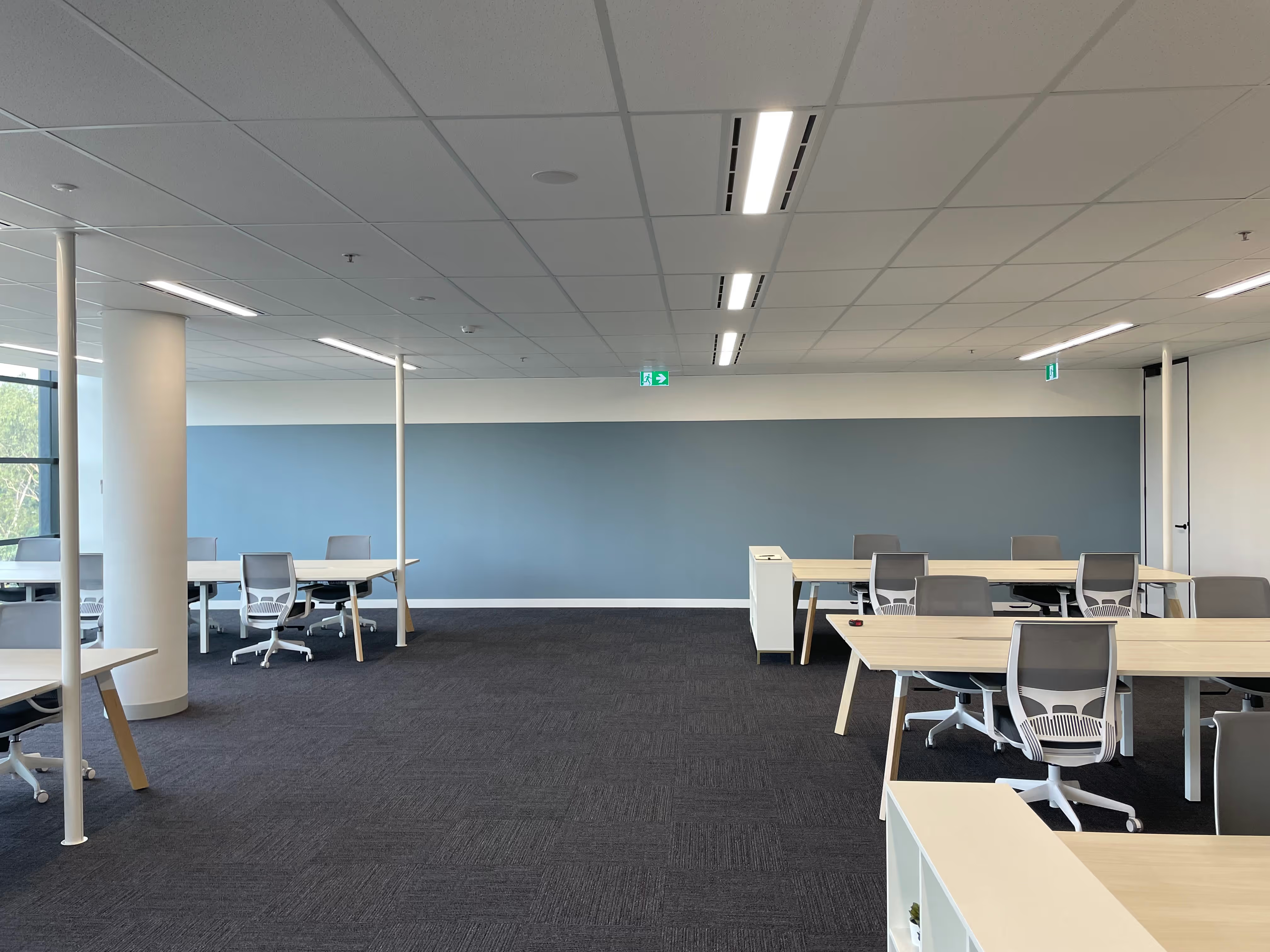
Volatile organic compounds (VOCs) are chemical solvents that evaporate into the air as paint dries. Traditional commercial paints can contain more than 120 g of VOCs per litre. As these compounds off-gas during and after application, they reduce indoor air quality, cause headaches, eye irritation, and respiratory discomfort in occupants, and can linger at elevated levels for days or weeks after a project is complete.
In a commercial setting, this is not merely a comfort issue. For facility managers, elevated post-paint VOC levels can mean delayed re-occupancy, complaints from tenants or staff, and, in sensitive environments like hospitals or childcare centres, a genuine health risk. The Australian Standard AS/NZS 2311:2017 provides guidance on VOC content for the painting of buildings, and the Green Building Council of Australia (GBCA) Green Star rating system awards Indoor Environment Quality credits where at least 95% of internally applied paints meet defined total VOC limits.
Understanding the categories makes procurement decisions clearer:
Note that tints added at point of sale can increase the VOC content of a zero-VOC base. Always request the total VOC figure for the ready-to-use tinted product, not just the base.
Which Commercial Sectors Should Prioritise Low-VOC Paint in NSW?
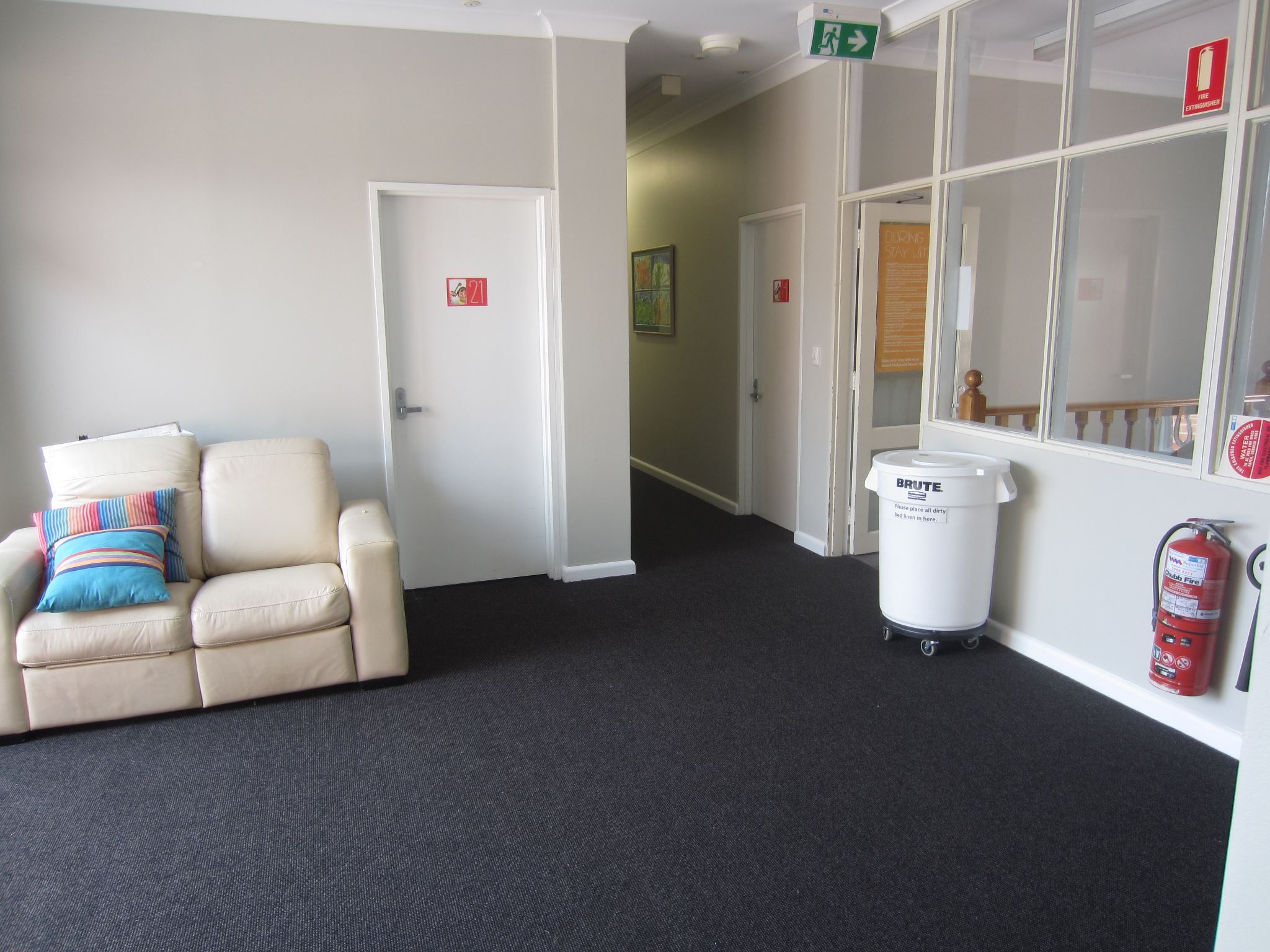
Not every commercial repaint requires ultra-low-VOC specification, but several sectors in NSW routinely do. The key driver is occupant vulnerability: the more sensitive the building’s users are to airborne chemicals, the more important it becomes to minimise off-gassing during and after painting works.
Premier Painting has delivered commercial painting programs for organisations across all of these sectors in Sydney, the Central Coast, and Wollongong, including healthcare facilities, educational institutions, and government buildings. Our Project Managers specify the appropriate product system for each environment as part of the initial scoping process.
Premier Painting’s commercial painting services cover low-VOC specification, sector-appropriate product selection, and dedicated project management on every job across Sydney, the Central Coast, and Wollongong.
Low-VOC Paint Requirements for Healthcare and Aged Care Facilities
Healthcare and aged care environments represent the highest-stakes application of low-VOC paint selection in a commercial context. Hospitals and medical facilities often operate 24 hours a day, meaning there is rarely a period when the building is fully unoccupied. Aged care facilities are home to residents with conditions including compromised respiratory function, heightened chemical sensitivity, and limited ability to relocate during disruptive works.
For these settings, very low-VOC or zero-VOC products are the appropriate specification. The Dulux envirO2 range, for example, is a very low-VOC system designed for interior applications where odour minimisation and rapid re-occupancy are priorities. Antimicrobial coatings that also carry low-VOC credentials are commonly specified in clinical zones.
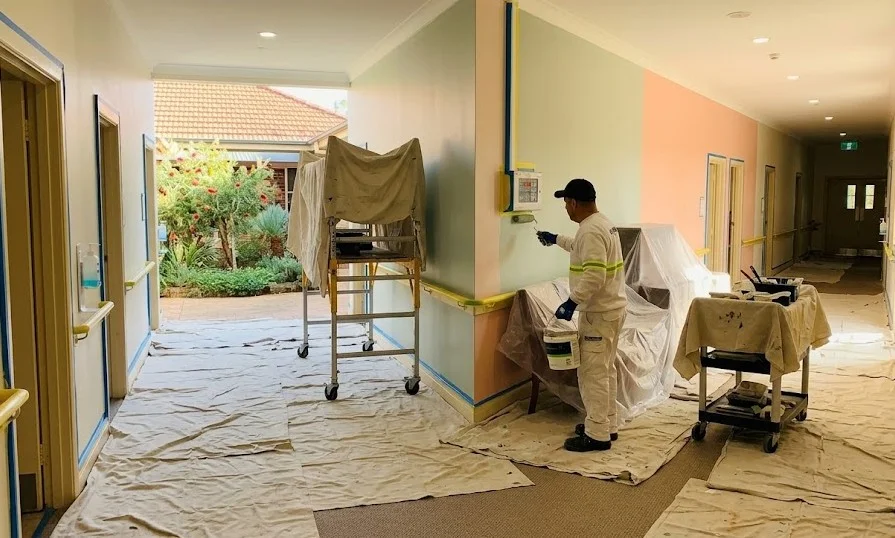
Scheduling is as critical as product selection in these environments. A qualified commercial painting contractor will plan works in staged zones, allowing each area to be cleared, painted, ventilated, and returned to service before moving to the next. A dedicated Project Manager is essential for maintaining this sequence, communicating with facility staff, and adapting to the operational realities of a live healthcare environment.
Pro tip: In aged care facilities, odour is not just a comfort concern. Many elderly residents have heightened sensitivity to chemical smells, and the psychological impact of paint odour in their living space is a legitimate quality-of-care consideration. Zero-VOC specification is standard practice in quality-focused aged care painting programs.
Childcare Centres and Schools: Why GECA Certification Matters
Children are more vulnerable to airborne pollutants than adults. They breathe faster relative to their body size, spend more time close to floor level, and have developing respiratory and immune systems that are more easily affected by chemical exposure. This makes low-VOC paint selection particularly important in childcare centres and school buildings.
For childcare and education settings, GECA (Good Environmental Choice Australia) certification is the clearest marker of compliant product selection. Products certified under the GECA Architectural and Protective Coatings standard automatically satisfy the GBCA Green Star VOC compliance requirements. When a contractor specifies GECA-certified low-VOC paint for a childcare or school repaint, the facility operator has straightforward evidence of compliance to present to regulators, parents, or certification assessors.
In practice, scheduling also matters as much as product choice. For childcare centres, painting works are typically planned across school holiday periods to avoid any concurrent occupancy. Where this is not possible, zero-VOC products and thorough ventilation between sessions are the minimum required approach.
Office Buildings and Green Star: How Low-VOC Paint Earns Credits
For commercial office buildings in Sydney pursuing GBCA Green Star certification or seeking to maintain an existing rating, the paint specification contributes directly to the Indoor Environment Quality credit category. The Green Star IEQ credit for reduced pollutant exposure awards points where at least 95% of all internally applied paints meet the defined total VOC limits. Where over 50% of paints by volume have a maximum total VOC content of 5 g/L or less, additional points are available for ultra-low-VOC compliance.
Beyond certification, low-VOC specification in office environments simply makes commercial sense. Tenant re-occupancy after a repaint is significantly faster with low-VOC products, reducing lost productivity and minimising the window in which workers are exposed to off-gassing. For facility managers managing live tenanted buildings, this is a practical scheduling benefit as well as a compliance consideration.
Common mistake: Specifying standard commercial paint for a Green Star-rated building, then discovering post-application that it does not meet GBCA VOC thresholds. The time to confirm product compliance is before the paint is purchased, not after it has been applied.
What Facility Managers Should Ask When Specifying Low-VOC Commercial Painting
When briefing a commercial painting contractor on a low-VOC project, the following questions should be part of the specification process:
- What is the total VOC content of the specified product in g/L of ready-to-use tinted paint? Base paint VOC figures can be misleading if tints push the final figure above the threshold.
- Does the product carry GECA certification or APAS approval? These third-party certifications provide documented evidence of compliance for sustainability reporting and regulatory review.
- Is the contractor Dulux Accredited? Dulux Accreditation confirms the contractor is authorised to apply Dulux product systems, including the envirO2 and other low-VOC ranges, in accordance with manufacturer specifications.
- How will staging and ventilation be managed? For occupied buildings, a written staging plan that accounts for zone clearance, application, drying time, and ventilation before re-occupancy is essential.
- What warranty applies? A reputable contractor will provide a workmanship warranty alongside the manufacturer’s product warranty. Premier Painting provides a 7-year workmanship warranty on all commercial projects, with 7–10 year manufacturer warranties available through Dulux and other major brands.
How Premier Painting Approaches Low-VOC Commercial Projects in Sydney
Premier Painting has delivered commercial painting programs for healthcare providers, educational institutions, aged care operators, and government bodies across Sydney, the Central Coast, and Wollongong for 28+ years. As Dulux Accredited Painters and a member of Master Painters Australia, our Project Managers specify low-VOC paint systems as a standard part of the pre-project scoping process, not as an afterthought.
Every commercial project includes a dedicated Project Manager and Supervisor. For sensitive environments, this means site-specific staging plans, clear communication protocols with facility staff and residents, and daily supervision to ensure application quality meets both the manufacturer’s technical specifications and our 7-year workmanship warranty standard.
Our approach to low-VOC specification follows the product data sheet exactly. This is particularly important because low-VOC paints typically have faster dry times than conventional products, requiring skilled application technique to achieve a consistent commercial-grade finish. Cutting corners on application in a low-VOC project often produces a visibly inferior result.
TL;DR: Low-VOC Commercial Painting at a Glance
- Low-VOC paints contain fewer than 50 g/L of volatile organic compounds; zero-VOC products contain less than 5 g/L. Always request the total VOC figure for the tinted, ready-to-use product.
- Healthcare, aged care, childcare, and occupied office buildings all have specific reasons to specify very low-VOC or zero-VOC products, ranging from patient health to Green Star certification requirements.
- The GBCA Green Star IEQ credit for reduced pollutant exposure requires at least 95% of internally applied paints to meet total VOC limits. GECA-certified products automatically satisfy this requirement.
- AS/NZS 2311:2017 provides the primary Australian Standard framework for painting of buildings, including VOC guidance. Always confirm product APAS approval and GECA certification where required.
- Product selection alone is not sufficient. Correct application technique and a site-specific staging plan are equally important, particularly in occupied healthcare and childcare environments.
Discuss Your Commercial Painting Project with Premier Painting
Premier Painting provides detailed, itemised proposals for commercial painting projects across Sydney, the Central Coast, and Wollongong, including full product specifications and VOC compliance documentation. Call us on 1300 916 291 or request a free quotation online.
Frequently Asked Questions
What is the difference between low-VOC and zero-VOC paint?
Low-VOC paints typically contain less than 50 g/L of volatile organic compounds. Zero-VOC paints contain less than 5 g/L in the base, though tints added at the point of sale can raise the final VOC level. For practical purposes, zero-VOC and ultra-low-VOC products are the right choice for sensitive environments such as aged care facilities, childcare centres, and occupied hospital wards.
Do low-VOC paints qualify for GBCA Green Star credits?
Yes. Under the Green Building Council of Australia Green Star rating system, paints contribute to the Indoor Environment Quality credits for reduced pollutant exposure. To earn these credits, at least 95% of all internally applied paints must meet stipulated total VOC limits. Products carrying GECA certification automatically satisfy the Green Star VOC compliance requirement.
Can commercial spaces be occupied while low-VOC painting is underway?
In many cases, yes. Low-VOC and zero-VOC products are specifically designed to allow faster re-occupancy by minimising the release of harmful fumes during and after application. For sensitive environments such as healthcare facilities and aged care homes, works are typically staged and scheduled to allow one zone to be vacated, painted, and ventilated before moving to the next.
Which Australian standard applies to low-VOC commercial painting?
AS/NZS 2311:2017 is the primary Australian Standard covering the painting of buildings, including guidance on VOC content and sustainable painting practices. Compliance with this standard, alongside product APAS approval and GECA certification where required, forms the technical baseline for low-VOC commercial painting specifications in NSW.
Do low-VOC paints perform as well as standard commercial paints?
Yes, when correctly specified and applied by an experienced commercial painting contractor. Modern low-VOC formulations from Dulux and other major manufacturers meet the same durability, washability, and scrub-resistance standards as conventional products. The key difference is in application technique: low-VOC paints tend to dry faster and require skilled handling to achieve a consistent commercial-grade finish.
How do I specify low-VOC paint for a commercial repaint in Sydney?
Request that your contractor provide a written product specification naming the paint system, VOC content in g/L, and any relevant certifications such as GECA or APAS approval. For Green Star-rated buildings, also confirm that the specified products meet the GBCA total VOC limits for the credit category being targeted. Premier Painting provides itemised proposals with full product specifications as standard.
Related Guides
- Commercial painting services in Sydney
- Checklist for commercial exterior painting
- 7 steps to ensure a flawless commercial paint finish
- Project management for painting
- Techniques for a flawless spray paint finish
- 5 mistakes when spray painting commercial spaces
- Paint maintenance extends the life of a building finish
About Premier Painting Company: Premier Painting has delivered commercial, strata, and residential painting across Sydney, the Central Coast, and Wollongong for 28+ years. Dulux Accredited Painters, a member of Master Painters Australia, CM3-accredited, IRATA-certified for rope access work, and a recognised Strata Services Specialist Company. Contact us on 1300 916 291 or visit premierpainting.com.au.







.png)

.png)