Why Commercial Paint Fails Early in Sydney (And How to Avoid It)
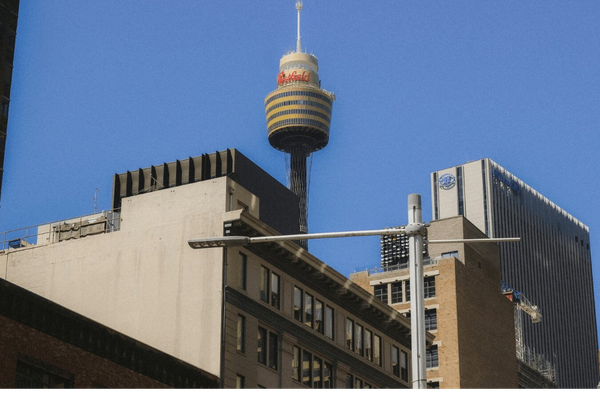
If you manage a commercial building in Sydney — whether it’s a retail facility in Parramatta, or a government building in the CBD — you’ve likely seen it: paint that looks fine one summer and is peeling, fading, or bubbling the next.
Commercial paint failing in Sydney is more common than it should be. And in most cases, it’s entirely preventable.
Sydney’s climate is genuinely demanding on exterior coatings. The combination of intense UV exposure, salt-laden coastal air, high humidity, and dramatic temperature swings between seasons creates conditions that expose every weakness in a paint system. When those conditions meet inadequate preparation, wrong product selection, or rushed application — early paint failure is the predictable result.
In this guide, we break down what paint failure looks like, the most common causes in the Sydney environment, and how a properly managed project avoids these problems entirely.
What Does Paint Failure Look Like?
Paint failure on a commercial building rarely happens all at once. It typically presents as one or more visible signs, each pointing to a different underlying problem. If you’re already seeing some of these warning signals, it’s worth reading our guide to the signs your commercial property needs repainting before the damage becomes a more costly remediation job. For a technical reference on identifying and resolving specific coating failures, the Australian Paint Manufacturers’ Federation also publishes a useful guide to common paint problems and how to solve them.
Types of Paint Failure
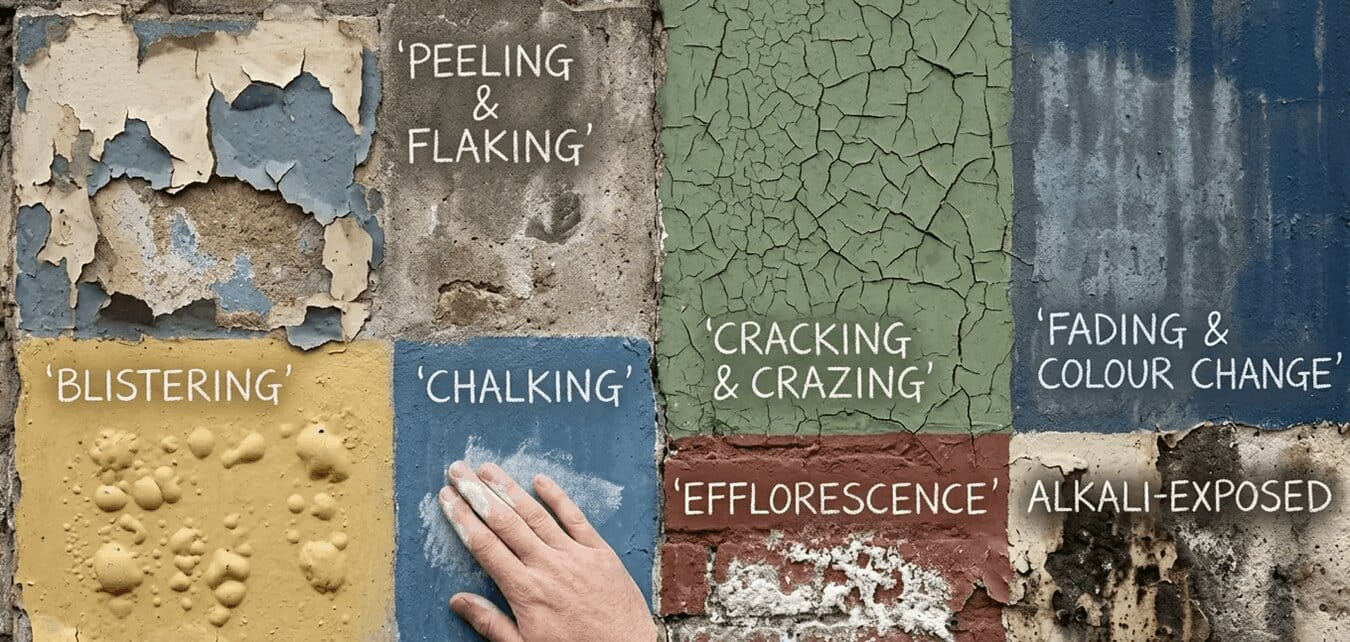
Peeling and Flaking
Paint lifts away from the surface in sheets or curls, exposing the substrate beneath. This is usually caused by poor adhesion — most commonly the result of inadequate surface preparation, a missing primer, or moisture trapped beneath the coating film at the time of application. On exterior commercial facades in Sydney, peeling that appears within the first two years almost always points to a preparation or priming failure rather than a product issue.
Blistering
Bubbles or blisters form beneath the paint film, ranging from small pin-sized pockets to large raised sections. Blistering is a moisture problem: either moisture vapour pushing through from the substrate, or heat causing trapped moisture to expand. In Sydney’s humid summer months, blistering is particularly common on surfaces that were painted before adequate drying time was allowed, or on surfaces with no breathable primer.
Chalking
The paint surface becomes powdery and rubs off on contact. This is UV degradation — the binder in the paint breaks down under prolonged sun exposure, leaving pigment particles that are no longer bound together. Some degree of chalking over many years is normal for exterior coatings, but premature chalking within two to four years indicates a product that was under-specified for Australia’s UV conditions, or insufficient film build. North-facing facades in Sydney are the most susceptible.
Cracking and Crazing
Fine or broad cracks appear across the paint surface, sometimes following the joints or cracks in the substrate beneath. Cracking is caused by a paint film that lacks sufficient flexibility to move with the substrate as it expands and contracts through temperature changes. In Sydney, where surface temperatures on concrete walls can swing more than 50°C between seasons, this is a significant risk for rigid paint systems on masonry or render.
Fading and Colour Change
The paint loses its original colour, fades unevenly, or shifts in tone. Fading is a UV-related failure of the pigment rather than the film itself. It is most visible on dark or saturated colours and on north and west-facing facades that receive the most sun exposure. In Sydney’s high-UV environment, colour retention is a key consideration in product specification — not all paints are formulated equally for Australian conditions.
Efflorescence
White, powdery salt deposits appear on the surface of masonry or concrete walls, often pushing through or beneath the paint film. Efflorescence occurs when soluble salts within the substrate are carried to the surface by moisture movement. It is common in Sydney’s older masonry commercial buildings and in coastal areas where salt can be both internal and external in origin. Paint applied over an active efflorescence problem will fail — the salts must be treated at the substrate level before any coating is applied.
Saponification
A greasy, soap-like breakdown of the paint film, typically occurring on new or recently rendered surfaces. Saponification is a chemical reaction between the high alkalinity of fresh cement render and oil-based or non-alkali-resistant coatings applied before the render has fully cured. It is entirely preventable with the correct alkali-resistant primer and adequate curing time — but remains one of the more common failures seen on commercial new-build and remediation projects.
Sydney’s Climate: Why It’s Harder on Paint Than You Think
Sydney is classified as a humid subtropical climate — but that description undersells its complexity. For exterior coatings on commercial buildings, the real challenge comes from several converging environmental stressors:
Intense UV Radiation
Australia has some of the highest UV radiation levels in the world. Sydney, sitting at latitude 33°S, receives significantly more UV exposure than equivalent latitudes in the northern hemisphere. This matters for paint because UV light degrades binder polymers — the component that holds pigment together and gives paint its film integrity. Without adequate UV stabilisers and the right paint chemistry, chalking, colour fade, and film breakdown begin within 12–18 months on north-facing facades.
Coastal Salt Air
For buildings within proximity to the coastline — covering a large portion of Sydney’s Eastern Suburbs, Northern Beaches, and harbour-adjacent suburbs — salt particles in the air accelerate paint deterioration significantly. Salt deposits create micro-alkalinity on surfaces, interfering with adhesion. On metalwork and concrete, salt also catalyses corrosion and carbonation that cause paint to lift from below.
Heat Cycling and Substrate Movement
Sydney summers regularly push surface temperatures on north and west-facing concrete and masonry walls above 60°C — while winters bring surface temperatures close to 5–8°C overnight. This thermal cycling causes substrates to expand and contract repeatedly. Paints that lack adequate flexibility crack and delaminate under this movement, particularly in older commercial buildings with hairline cracks already present in render or masonry.
Humidity and Moisture Ingress
Sydney’s humid summer months — particularly from November through March — create conditions where moisture can become trapped beneath coating films if application occurs in adverse conditions, or if surfaces were not properly dried before painting. This trapped moisture drives blistering and delamination, which is one of the leading causes of exterior paint peeling on commercial buildings across Greater Sydney.
The Most Common Causes of Commercial Paint Failing in Sydney
When we assess a commercial building where early paint failure has occurred, the root cause almost always falls into one of the following categories:
1. Inadequate Surface Preparation
This is the single biggest contributor to premature failure. Proper surface preparation for a commercial exterior in Sydney requires more than a pressure wash. It means removing all contaminants, treating and stabilising any existing chalking or friable surfaces, filling and profiling cracks appropriately, and ensuring surfaces are dry and sound before any primer is applied.
When preparation is rushed — particularly on repaint projects where the existing coating is already compromised — the new system fails at the weakest point in the existing substrate. Paint can only be as good as what it’s applied over.
2. Wrong Product Selection for the Substrate and Exposure
Not all acrylic paints are created equal — and the difference between an entry-grade acrylic and a high-build elastomeric membrane system designed for exposed coastal concrete is significant. Using a residential-grade product on a multi-storey commercial facade in Bondi or Maroubra is a guarantee of early failure.
Sydney’s coastal and UV conditions demand products formulated specifically for high UV, high humidity, and high movement environments. Systems like Dulux Weathershield, Dulux Acratex texture systems, and Dulux Elastomeric waterproofing membranes are designed for exactly these conditions — but they must be specified correctly for each substrate type, exposure rating, and building condition.
3. Application in Adverse Conditions
Paint applied in direct midday sun on a hot Sydney summer’s day — when surface temperatures may exceed 50°C — risks failing almost immediately. The solvent in the coating flashes off too quickly, preventing proper film formation. Similarly, painting in high humidity or immediately before or after rain leads to moisture-related adhesion failure.
An experienced commercial painting team manages application conditions actively: working in sequence around a building to follow shade, monitoring temperature and humidity, and adjusting working methods and products accordingly.
4. Insufficient Film Build
Commercial paint specifications — including minimum dry film thickness requirements — are governed by AS/NZS 2311:2009, the Australian and New Zealand standard for the preparation and painting of buildings. When contractors cut corners on product quantity — spreading paint too thinly to stay within a low budget — the system doesn’t achieve the film build required to resist UV, moisture, and physical wear. On a large commercial building, the financial saving is marginal; the consequences for performance are significant.
5. Missing or Incorrect Priming
Priming is not optional — it is the foundation of every commercial coating system. The primer creates adhesion to the substrate, seals porosity, and provides the bond coat for subsequent layers. On concrete and masonry, a penetrating sealer primer is essential in Sydney’s coastal environment. On new render, an alkali-resistant primer prevents saponification — a chemical reaction between the alkalinity of fresh render and paint that causes catastrophic adhesion failure.
6. No Planned Maintenance Programme
Even the best commercial coating system in the world has a finite service life. Buildings with no structured maintenance painting programme — no scheduled wash-downs, no periodic inspection of sealants and joints, no planned repaint cycle — typically face significantly more expensive remediation work when failure does occur.
In Sydney’s environment, a well-specified exterior commercial coating system should be expected to perform for 8–12 years with appropriate maintenance. Without it, that timeline can compress to 3–5 years. For practical advice on what that maintenance should include, see our guide on how to extend the life of your commercial paint job.
What a Properly Specified Commercial Paint Project Looks Like
The difference between a commercial paint job that lasts and one that fails early is almost always process. Here’s what a properly managed project looks like at each stage:
Pre-Project Assessment
Before a brush goes near a wall, an experienced commercial painter assesses the existing condition of all surfaces: the degree of chalking or adhesion failure, the presence of moisture, the condition of sealants and expansion joints, the proximity to salt air, and the orientation of facades relative to sun exposure. In Sydney, north and west-facing elevations are always higher risk and require specific attention to product and film build.
Surface Preparation to Specification
For a commercial repaint in Sydney’s coastal or high-UV zones, preparation typically includes high-pressure water cleaning (minimum 3,000 PSI for concrete), removal of all failing paint and contaminants, crack filling with appropriate flexible filler or render, full priming with a substrate-appropriate primer, and a pre-paint inspection before any topcoat is applied.
Correct Product System Selection
The paint system should be specified to match the substrate type, the exposure conditions, and the required service life. On Dulux Accredited projects, this means selecting from proven systems — Weathershield Max for standard commercial facades, Acratex texture systems for masonry with surface irregularities, or Elastomeric membranes for flat roofs and surfaces with active cracking.
Controlled Application
All application occurs within manufacturer-specified temperature and humidity windows. In Sydney summers, this typically means early morning application on sun-facing facades. Surface temperature is monitored actively, and working methods are adjusted to ensure consistent film build.
Quality Assurance and Inspection
A well-managed commercial project includes formal quality checkpoints at each phase — after preparation, after priming, and after each topcoat. In NSW, acceptable standards of workmanship for painting are also outlined in the NSW Fair Trading Guide to Standards and Tolerances, which provides a useful reference for building owners and managers assessing the quality of completed work. A Dulux Accredited contractor has access to Dulux’s technical support team for specification review and can offer warranted systems backed by Dulux’s manufacturer guarantee.
Planned Maintenance Programme
At project completion, a long-term maintenance schedule should be established: when to schedule wash-downs, when to inspect sealants, and when to plan the next repaint cycle. For strata and commercial facility managers in Sydney, this kind of maintenance schedule is also a valuable tool for capital works planning and strata committee reporting.
A Note on Painting Sydney’s Coastal Suburbs: Higher Risk, Higher Specification Required
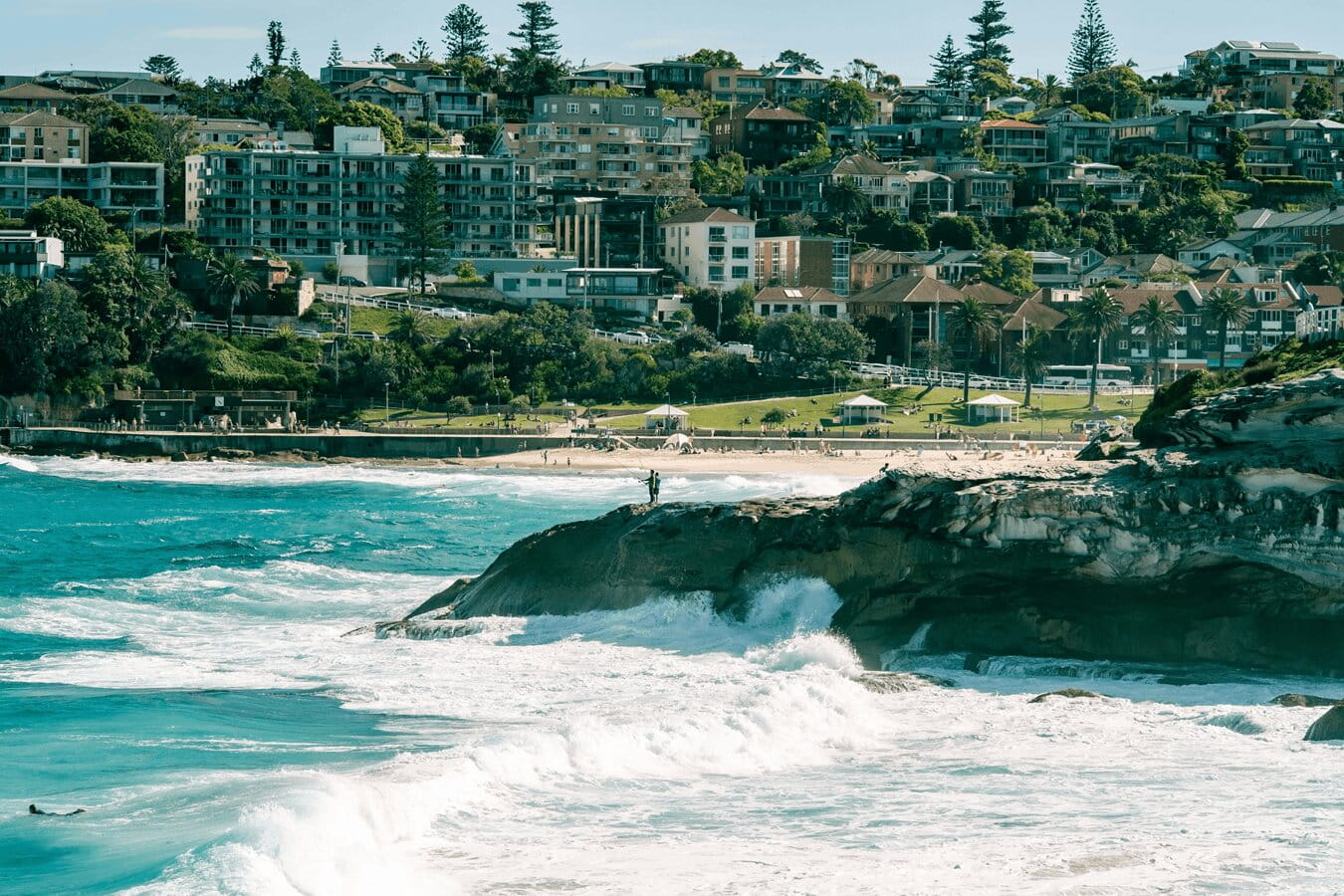
If your commercial building sits within 1–2 kilometres of the coast — covering a very large proportion of the Eastern Suburbs, Northern Beaches, and areas around Sydney Harbour — the specification requirements for exterior coatings are stricter, and the consequences of using unsuitable products are faster and more visible.
In coastal Sydney environments, we recommend:
– Elastomeric or high-build texture systems on concrete and masonry facades
– Additional consideration of anti-carbonation coatings on older concrete buildings
– Salt-resistant primers on all metalwork
– More frequent scheduled wash-downs to remove salt accumulation
– Inspection of sealants and expansion joints as part of every maintenance visit
Buildings in suburbs such as Bondi, Coogee, Manly, Mosman, Balmain, Bronte, Cronulla, and coastal Central Coast locations including Terrigal, Avoca Beach, and Ettalong Beach fall into this higher-specification category. The same principles apply to our Wollongong service area, where coastal exposure along the Illawarra escarpment creates comparable conditions.
Talk to Sydney’s Commercial Painting Specialists
Premier Painting Company has delivered commercial painting services since 1997 across Greater Sydney, the Central Coast, Newcastle, and Wollongong. Every project is backed by a 7-year workmanship warranty, Dulux Accreditation, and a dedicated Project Manager and Supervisor — with all painters directly employed delivering a quality finish every time.
If your building is showing signs of paint failure, or you’d like a properly specified commercial paint programme, contact us for a free site assessment and quotation.
Call 1300 916 291 or visit premierpainting.com.au/request-a-quote
Frequently Asked Questions
Why is exterior paint failing on my commercial building?
The most common causes are inadequate surface preparation, wrong product specification for the substrate or exposure conditions, application in adverse weather, insufficient film build, or missing primer. Sydney’s UV intensity, coastal salt air, and heat cycling between seasons accelerate these failures significantly. A professional site inspection is the most reliable way to identify the specific cause.
How do I prevent commercial paint failure in high-traffic areas?
Specify a coating system rated for abrasion and impact resistance — two-pack epoxy and polyurethane systems are standard for commercial high-traffic areas such as car parks, corridors, and loading docks. Thorough surface preparation and the correct number of coats to reach specified film thickness are equally important. A planned maintenance schedule, including regular cleaning and early touch-up of damaged areas, will extend the coating life significantly.
What are the best commercial paint brands for weather resistance in Australia?
For commercial exteriors in Australia’s high-UV and coastal conditions, the well-established systems include Dulux Weathershield and Weathershield Max for standard facades, Dulux Acratex for masonry and textured surfaces, and Dulux Elastomeric for surfaces with active cracking or requiring waterproofing capability. Product selection should always be matched to the specific substrate and exposure conditions by a qualified commercial painter.
What products fix commercial paint chalking in Australia?
Chalking must be addressed at the substrate level before repainting. The chalked surface should be thoroughly cleaned by high-pressure washing, then treated with a penetrating sealer or consolidating primer — such as Dulux Sealer Binder or Dulux Acratex Primer Sealer — to re-establish a sound base. A UV-resistant exterior topcoat applied to the correct film build will then provide warranted performance. Painting over chalking without preparation will cause the new system to fail.
Where can I buy commercial-grade paint that resists peeling?
Commercial-grade exterior coatings are available through trade paint suppliers, including Dulux Trade Centres across Greater Sydney, the Central Coast, and Wollongong. For most commercial building owners and managers, the more practical approach is to engage a qualified commercial painting contractor who specifies and supplies the correct system as part of the project scope. Contact Premier Painting on 1300 916 291 to arrange a free quotation.







.png)

.png)