EOFY Commercial Painting: Why Deferring Costs More Than You Think

Quick answer: Deferring a commercial repaint past 30 June means losing budget allocation, losing schedule priority with contractors, and carrying a deteriorating asset into another season. For most facility managers, acting before EOFY is the lower-risk decision. Premier Painting has delivered commercial painting across Sydney, the Central Coast, and Wollongong for 28+ years. Contact us as soon as possible to understand what is still achievable before 30 June.
Most facility managers already know whether their building needs a repaint. The decision they are actually making in May is not whether to paint — it is whether to act before 30 June or push it to next financial year. Commercial painting deferred past EOFY rarely saves money. It costs budget allocation, schedule position, and leaves a deteriorating building carrying another season of wear. This post makes the case for acting now, covers what the process actually involves, and answers the questions facility managers most commonly ask before committing.
Why Deferring a Commercial Repaint Past EOFY Costs More Than It Saves
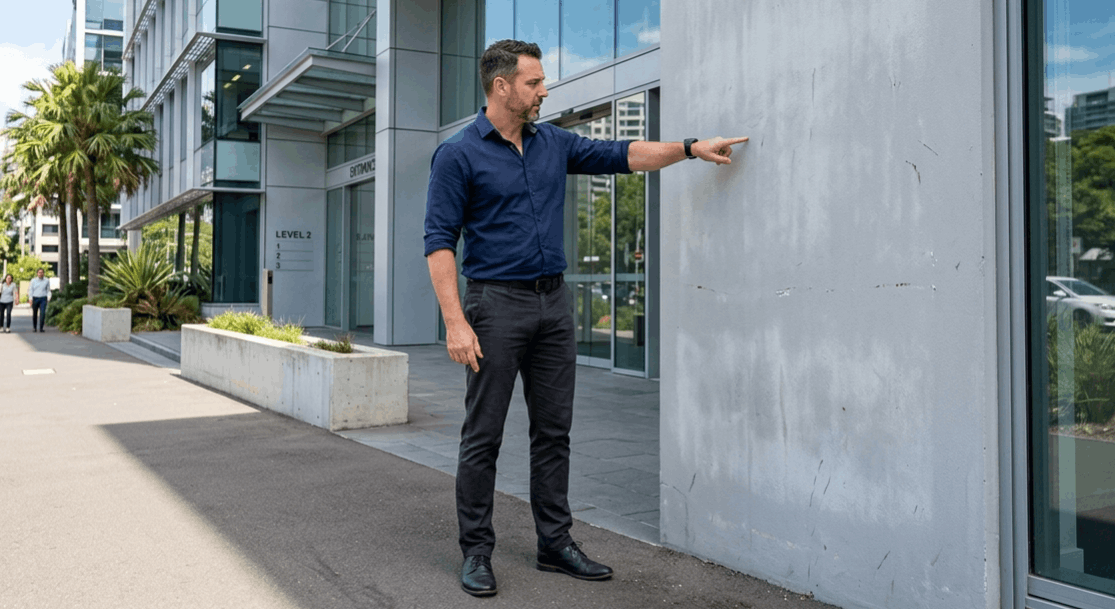
There are three common reasons facility managers push a repaint past 30 June: the budget has not been formally approved, the schedule feels tight, or there is a preference to avoid disruption at the end of a busy period. None of them changes what actually happens when the work is deferred.
Unspent maintenance budgets often do not roll over
Funds allocated to painting or building maintenance that are not committed before 30 June are frequently absorbed or reallocated in the new financial year — sometimes at a reduced level, sometimes not at all. A project approved in principle this year may need to go back through the approval process next year.
Contractor availability is seasonal
May and June are among the busiest months for commercial painting contractors across Sydney. Buildings that secure their position now start in June. Those that make contact too late find June is full — pushing works to July or August, which delays the asset improvement by another two to three months and does nothing for this year's budget.
The building does not pause
Paintwork flagged for attention continues to deteriorate while the scheduling decision is made. Surface breakdown that could be addressed at standard repaint cost this year may require additional remedial work — render repairs, waterproofing membrane application, or substrate treatment — by the time it is revisited next year. That scope addition is real additional cost, not a saving from having waited.
Which Organisations Benefit Most from an EOFY Commercial Repaint
Not every building is equally well-positioned for an EOFY repaint. The following types of organisations consistently get the most value from acting before 30 June.
| Organisation type | Why EOFY works well |
|---|---|
| Government departments and public sector agencies | Strict annual budget cycles with hard acquittal deadlines. Painting is a visible, compliant, documentable expenditure that can be scoped, delivered, and recorded within the financial year. |
| Commercial office buildings | EOFY often aligns with lease transitions. A repaint completed before June supports revaluations, lease renewals, and new occupancy starting in July. |
| Strata managers and owners corporations | Where a repaint has been scoped and approved at the AGM but not yet contracted, EOFY is the natural point to commit before funds become vulnerable to reallocation. |
| Heritage and government buildings | Buildings with compliance overlays — asbestos management, lead paint protocols, or heritage fabric requirements — need more planning time. Acting early prevents the kind of rushed scoping that leads to compliance gaps. |
Across the property sector, the Property Council of Australia has consistently highlighted how deferred building maintenance compounds over time — minor surface breakdown that goes unaddressed accelerates structural deterioration and increases the eventual remediation cost. Commercial painting is one of the most cost-effective interventions available to property managers precisely because it protects the substrate before that cycle begins.
Premier Painting provides detailed, itemised proposals for every commercial painting project, structured to be approvable at committee or management level without additional interpretation. Contact us to arrange a site inspection.
What a Pre-EOFY Commercial Painting Scope Actually Involves
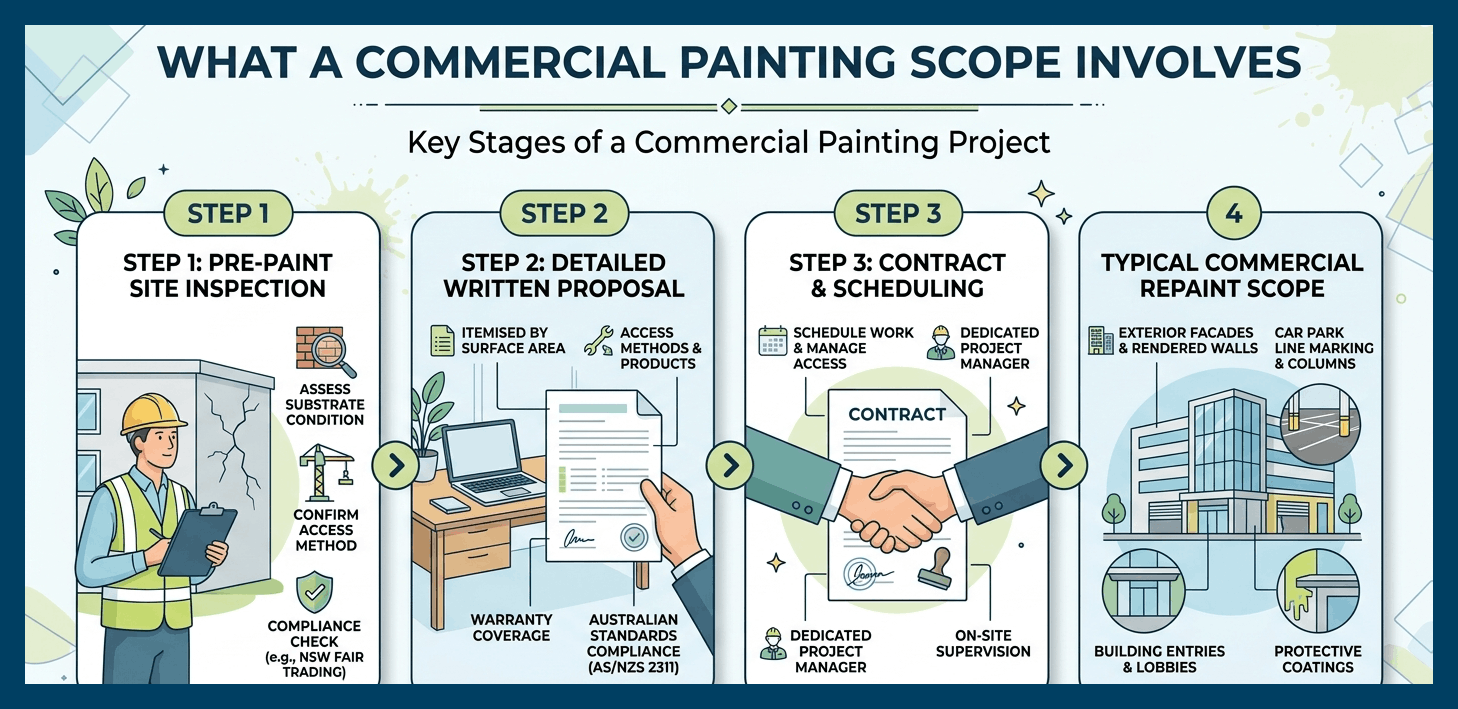
One reason deferral decisions happen is a perception that organising a commercial repaint before 30 June is more complicated than it is. In practice, the process is straightforward once a contractor is engaged.
Step 1: Pre-paint site inspection
A Premier Painting Project Manager assesses the building's substrate condition, identifies any remedial work required before painting begins, and confirms the access method. This typically takes at least one to two hours on site, depending on the volume of work identified. The inspection also establishes whether the building requires licensed contractor compliance under NSW Fair Trading rules — any trade painting work over $5,000 in labour and materials must be carried out by a licensed contractor, which is worth confirming before the EOFY rush leads to shortcuts.
Step 2: Detailed written proposal
The inspection results in a written proposal itemised by surface area, access method, product specification, and warranty coverage — structured to support committee or management approval. Products are applied in accordance with AS/NZS 2311, the Australian Standard for painting of buildings, which sets out the professional standards required for commercial durability and defines what constitutes a painting defect.
Step 3: Contract and scheduling
Once accepted, Premier Painting schedules the work and manages all access, materials, and on-site supervision throughout. Every commercial project has a dedicated Project Manager and Supervisor — from first inspection through to final sign-off.
A typical EOFY commercial repaint scope covers exterior facades and rendered walls, car park line marking and columns, building entries and lobbies, and any protective coating work identified during the inspection. Keeping the building's paintwork performing well between major repaints is covered in our commercial paint job maintenance guide.
Tax Treatment and Budget Commitment: What You Need to Know
Painting is one of the expenses the ATO explicitly identifies as deductible repair and maintenance. Under TR 97/23 — the ATO's definitive ruling on repairs versus improvements — work that restores a building to its previous condition is deductible as a repair in the year the expense is incurred. Work that improves the building beyond its original state may need to be depreciated as capital works. For most routine commercial repaints, the immediate deduction applies.
The ATO's small business guidance on repairs and maintenance confirms that painting costs are often fully deductible in the year incurred, a meaningful cash flow benefit when works are completed before 30 June rather than deferred into the new financial year.
The deduction is tied to when the expense is incurred, which is generally when the work is performed and invoiced, not when the contract is signed. A signed contract before 30 June secures schedule position and typically satisfies the internal budget commitment requirement, but whether it delivers the tax deduction this financial year depends on when the work is completed. Confirm with your accountant.
Where works cannot be completed before 30 June, a practical option is to stage the scope: surface preparation, priming, and remedial work in the current financial year; topcoats and finishing in the new financial year. Premier Painting can structure proposals to accommodate this. More on managing commercial painting as a long-term asset strategy: what to include when budgeting for a commercial repaint.
How Much Lead Time You Actually Need Before 30 June
Six to eight weeks is the realistic minimum to lock in a commercial repaint before EOFY: enough time for a site inspection, proposal preparation, internal approval, and contract execution. For buildings requiring scaffold, elevated work platforms, or rope access, ten to twelve weeks is advisable to secure your position. Lead times vary by contractor and project complexity, so confirm availability directly with your painting contractor as early as possible.
| Building type | Recommended lead time | Key constraint |
|---|---|---|
| Standard commercial repaint, no height access | 6–8 weeks | Site inspection, proposal, approval, crew mobilisation |
| Buildings requiring EWP or mobile scaffold | 8–10 weeks | Access equipment availability during peak season |
| High-rise or complex access (rope access, fixed scaffold) | 10–12 weeks | Crew scheduling, specialist access equipment, and site-specific logistics |
| Government or heritage buildings | 10–12 weeks | Compliance documentation, background screening, and multi-layer approval |
With June approaching, the window is narrow. Contact a contractor as soon as possible to understand what is still achievable before 30 June and whether a staged scope makes sense if full completion is not feasible in time.
Premier Painting is a Dulux Accredited painting contractor with CM3-accredited safety systems, operating across Sydney, the Central Coast, and Wollongong. Every project is managed by a dedicated Project Manager and Supervisor on site, and all workmanship is backed by a 7-year workmanship warranty and 7–10 year manufacturer warranties.
Book a Free Commercial Painting Assessment Before 30 June
Contact Premier Painting on 1300 916 291 or schedule a free assessment. We cover Sydney, the Central Coast, and Wollongong. The sooner you make contact, the more options you have before 30 June.
Frequently Asked Questions
Is commercial painting tax deductible before EOFY?
Generally yes, if the work is repair and maintenance rather than capital improvement. Under TR 97/23, the ATO allows an immediate deduction in the year the expense is incurred for like-for-like repaints that restore a surface to its original condition. Capital improvements are depreciated over time. Confirm your circumstances with your accountant before committing.
How far in advance should I book a commercial painter before 30 June?
Six to eight weeks minimum for most commercial repaints. Buildings requiring scaffolding, elevated work platforms, or rope access typically need ten to twelve weeks. With June approaching, contact a contractor as soon as possible to understand what is still achievable in the current financial year.
What is typically included in a pre-EOFY commercial repaint scope?
Surface preparation, exterior facade painting, interior common areas such as lobbies and corridors, car park line marking, and any protective coating work identified during the pre-paint inspection. Premier Painting provides a detailed, itemised written proposal for every project before any budget is committed.
What surfaces should I prioritise in an EOFY building repaint?
Exterior facades, rendered walls, building entries, and car park areas first — these have the greatest impact on asset condition and tenant perception. Interior office spaces and specialist coatings can often be deferred if budget is tight. Any surface showing active deterioration should be addressed regardless of timing.
Can I commit my maintenance budget before 30 June even if the work starts later?
Many organisations issue a purchase order or sign a contract before 30 June to commit the spend to the current financial year, even if works begin in July. The ATO's deductibility rules are tied to when the expense is incurred, not when it is contracted. Confirm the correct treatment with your accountant and ensure your contractor can provide a formal written agreement.
If your building is due for a repaint, Premier Painting's Project Managers are available for site inspections across Sydney, the Central Coast, and Wollongong. Contact us on 1300 916 291 or request a free quotation at premierpainting.com.au/request-a-quote. The sooner you make contact, the more options you have before 30 June.







.png)

.png)