Understand Your Building’s Life Cycle: When to Repaint and Why Some Buildings Last Longer
By Tony Conway, Managing Director, Premier Painting Company
Quick answer: Most buildings need repainting every 7 to 10 years, but exterior repaint and interior repaint cycles differ significantly. Exterior surfaces face weather and UV exposure and typically follow the 7 to 10 year cycle, while interior areas wear from daily traffic and often need attention every 3 to 5 years. Strata, commercial, and government buildings each have different drivers behind that timeline. Premier Painting backs every project with a 7-year workmanship warranty.
Property painting is rarely a single decision made once and forgotten. How often should you repaint a building depends on whether you're maintaining an exterior facade exposed to Sydney's coastal weather or an interior common area worn down by daily foot traffic. Strata committees, commercial property managers, and government facility managers all face this question, but the right answer looks different for each. Understanding the factors that drive exterior repaint and interior repaint cycles helps you plan ahead, budget accurately, and avoid the higher costs of delayed maintenance.
Why Repainting Matters
Paint is more than just colour. It acts as a protective barrier against the elements, whether on a strata building's exterior render, a commercial office's facade, or a government asset's heritage stonework. Over time, sunlight, rain, pollution, and general wear break down that barrier. Repainting on schedule helps prevent issues like water damage, corrosion, and concrete cancer. It also keeps every type of property looking well maintained, which matters for resident amenity, tenant impressions, and public confidence in government-managed assets alike.
When Should You Repaint?
The typical repaint cycle for strata buildings is every 7 to 10 years, though commercial and government buildings can vary depending on use, exposure, and asset management requirements. Several key factors influence when repainting is due, regardless of sector.
1. Weather Conditions
Buildings near the coast are exposed to salt spray and humidity, which can speed up paint deterioration. Further inland, harsh sun or heavy rainfall can have a similar effect. In Sydney's mixed climate, it's important to keep a close eye on your building's condition.
2. Pollution Levels
Buildings located near busy roads, industrial areas or construction zones often show signs of wear more quickly. Airborne pollutants and dust can break down paint and leave the building looking tired and dirty.
3. Substrate Type and Condition
Not all surfaces age the same way. Brick, render, concrete and metal all respond differently to environmental conditions. A well-prepared surface will hold paint longer. If the initial preparation or paint system was not up to standard, deterioration will likely occur sooner.
4. Previous Paint System
The type of paint previously used makes a big difference. High-performance membranes generally last longer than basic acrylic systems. These premium options are often worth the investment, especially for high-rise or exposed sites.
5. Maintenance Routine
Buildings that are regularly cleaned and maintained tend to enjoy a longer life between repaints. Even a basic soft wash can remove grime and help extend the life of the existing coating.
Repaint Cycles by Building Type: Strata, Commercial & Government
While the 7 to 10 year window is a useful baseline, the drivers behind that cycle differ across strata, commercial, and government properties. Owners corporations plan around AGM budget approval, commercial property managers weigh tenant presentation and lease cycles, and government facility managers work within asset management and procurement frameworks. The table below summarises how these drivers typically shape repaint timing.
Repaint Intervals by Surface Material
Building type isn't the only variable. The substrate itself has its own lifespan under paint, and a well-scoped strata painting services proposal should account for this alongside the sector-based cycle above.
- Render and masonry: typically 7 to 10 years, longer with proper surface preparation
- Metal and structural steel: typically 3 to 5 years, shorter near coastal salt exposure
- Timber: typically 3 to 7 years, dependent on maintenance and exposure
- Concrete: typically 7 to 10 years, extended with waterproof membrane coatings where applicable
Horizontal surfaces such as window sills and parapet capping face the most intense UV exposure in the Australian climate. Heritage NSW's technical guidance on paint finish failure explains why these areas are typically the first to show crazing, flaking, and colour fading, regardless of building type.
Exterior Repaint Considerations
Exterior repaint work carries the greatest exposure to Sydney, Central Coast, and Wollongong's mixed climate: UV degradation, salt air on coastal buildings, and driving rain against facades, parapets, and balconies. An experienced exterior painters team will assess substrate condition before quoting rather than applying a standard timeline. On strata and commercial buildings, this often includes checking for render cracking, efflorescence, and areas where a waterproof membrane coating may be required ahead of the decorative finish. The painting specification itself should follow recognised standards such as AS/NZS 2310, which governs painting systems for buildings and structures in Australia. Regular cleaning and minor touch-ups can meaningfully extend this timeline: service life prediction research for painted renders has tracked well-maintained exterior coatings performing well beyond 15 years.
Interior Repaint Considerations
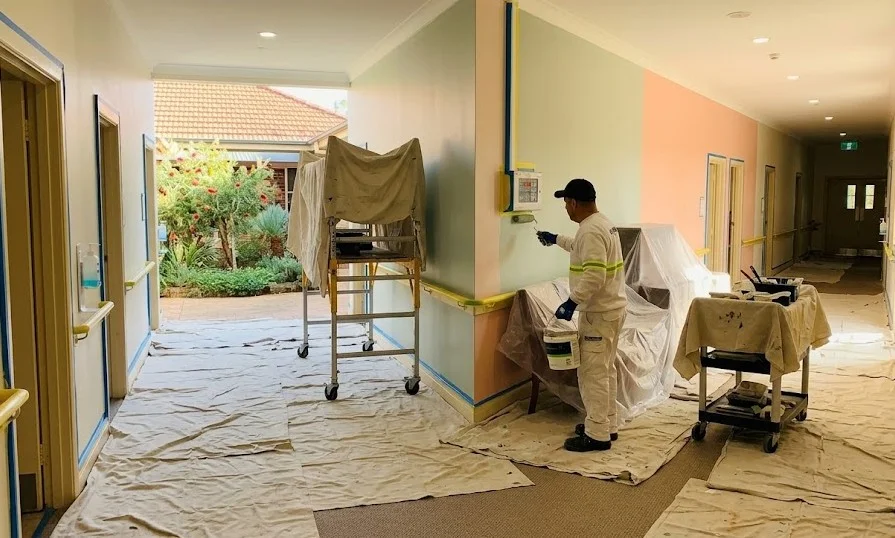
Interior repaint cycles are typically driven by traffic rather than weather. Lift foyers, common hallways, and lobbies in strata and commercial buildings often need attention every 3 to 5 years, while lower-traffic offices and private areas can go longer between coats. Government facilities managing public-access areas face similar wear patterns, with added compliance requirements around product selection in occupied buildings. Many Sydney buildings predate 1970, and interior repaint work on these properties should factor in NSW EPA's guidance on lead-based paint safety before any sanding or surface preparation begins. A qualified interior painters team will sequence work to minimise disruption to residents, tenants, and staff, often scheduling around occupancy hours or working in stages across a financial year.
Premier Painting's commercial painting services include a full pre-paint assessment covering both exterior and interior scope, so your budget reflects the actual condition of the building rather than a generic timeline.
Why Government and Commercial Buildings Have Different Repaint Drivers
Commercial property managers are usually driven by tenant presentation and brand consistency, particularly in retail and office environments where a tired facade affects first impressions. Government and heritage asset managers work within a different framework: procurement processes, compliance documentation, and public accountability for how maintenance budgets are spent. For heritage-listed commercial and government assets within Sydney's conservation areas, repaint specifications must also comply with the City of Sydney's heritage repainting guidelines, which set out requirements for breathable, vapour-permeable paint systems on traditional masonry. Both sectors benefit from a dedicated Project Manager who can produce the detailed, itemised proposals required to support internal approval processes, whether that's a facilities committee or a strata owners corporation vote.
Pro tip: Spray application, where appropriate for large exterior facades, often produces a more consistent finish and reduces scaffold or EWP hire duration, which can extend the practical value of a repaint cycle without changing the underlying material lifespan.
Signs It's Time to Repaint
- Peeling, flaking or bubbling paint
- Discolouration or fading
- Mould or mildew stains
- Powdery residue when you touch the surface
- Water stains or rust marks
- Cracks or gaps in joints and trims
If any of these issues are visible, it's worth speaking with your strata committee, property manager, or facility manager about arranging an inspection.
Plan Ahead and Protect Your Property
Understanding your building's life cycle allows you to take a proactive approach. Repainting on time is far more cost-effective than repairing damage caused by delayed maintenance.
Premier Painting has been helping strata owners and managers extend the life and appearance of their buildings since 1997, and we provide the same standard of assessment for commercial and government properties. Our experienced team can assess your property, recommend the right time to repaint and ensure the work is carried out efficiently and professionally.
TL;DR — Building Repaint Cycles at a Glance
- Exterior repaint cycles typically run 7 to 10 years; interior repaint cycles are shorter, often 3 to 5 years in high-traffic areas
- Strata, commercial, and government buildings share similar substrate lifespans but different budget and approval drivers
- Coastal exposure across Sydney and the Central Coast can shorten exterior repaint cycles
- A pre-paint inspection identifies whether waterproofing or render repairs are needed before the decorative coat goes on
- Premier Painting backs every project with a 7-year workmanship warranty
- Next step: contact Premier Painting for a free quote → 1300 916 291 or request a free quotation
Book a Free Building Assessment
Whether you're managing a strata building, a commercial property, or a government asset, Premier Painting can assess your exterior and interior repaint needs and provide a detailed, itemised proposal. Call us on 1300 916 291 or request a free quotation online.
Frequently Asked Questions
How often should a commercial building be repainted in NSW?
Most commercial buildings in NSW need repainting every 5 to 10 years, though tenant turnover, coastal exposure, and facade material affect the exact interval. Buildings in high-traffic retail or hospitality settings often repaint sooner to maintain brand presentation, while office towers with lower exterior wear can extend towards the 10-year mark with proper maintenance.
Do government buildings have different repainting requirements than commercial buildings?
Government and heritage buildings typically follow a 7 to 12 year repaint cycle, driven by asset management schedules and compliance documentation rather than tenant presentation alone. Heritage sites also require heritage-appropriate paint systems and, in older buildings, lead-based paint hazard management compliant with AS/NZS 4361.2 before any repaint proceeds.
Does the type of surface affect how often a building needs repainting?
Yes. Render and masonry typically last 7 to 10 years under paint, metal and structural steel often need repainting every 3 to 5 years due to corrosion risk, and timber surfaces generally require attention every 3 to 7 years. Surface preparation quality has a greater effect on lifespan than the paint product itself.
How do strata, commercial, and government repaint cycles differ?
Strata repaint timing is shaped by owners corporation budget approval and resident disruption, commercial cycles by tenant presentation and lease turnover, and government cycles by procurement processes and asset compliance requirements. The underlying substrate lifespan is similar across all three, but the approval pathway and timing drivers differ.
What's the cost of delaying a building repaint?
Delaying a repaint beyond the point where paint has failed allows water ingress, corrosion, and substrate damage to progress, which typically costs significantly more to repair than a scheduled repaint. A pre-paint inspection during the recommended 7 to 10 year window is the most cost-effective way to protect the building envelope.
Related Resources
- Strata Painting Services
- Planned Maintenance Schedule for Strata Buildings
- Heritage and Goverment Painting Services
- Waterproof Membrane Coatings for Strata Buildings in NSW
- Paint Maintenance That Extends the Life of a Building's Finish
About Premier Painting Company: Premier Painting has delivered strata, commercial, and government painting projects across Sydney, the Central Coast, and Wollongong for 28+ years. Dulux Accredited Painters, a member of Master Painters Australia, CM3-accredited, IRATA-certified for rope access work, and a recognised Strata Services Specialist Company. Contact us on 1300 916 291 or visit premierpainting.com.au.







.png)

.png)